Dogged by debt, dreams, and fear Moira descends into the oldest part of the city, searching for the one place her questions can be answered–the Crossroads Clock.
If you like this you can support me on Patreon.
The Toymaker’s Opera is an alternative-world steampunk adventure. It is a story about a poor fortuneteller, a living automaton, a mad Baron, and a city that dreams. It is a story about the price of friendship and happiness, about legacy and talent, blood and luck. But most of all, it is a story about the things that have no price.
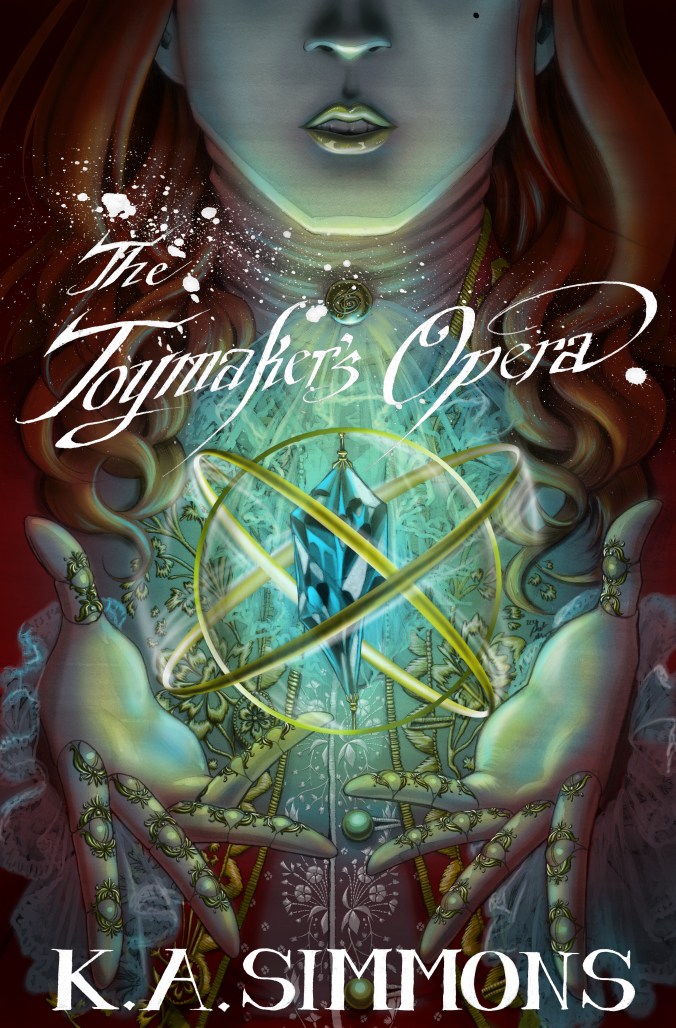
The Toymaker’s Opera
The Crossroads Clock
Moira
Beneath the Teeth, deep in a blackness that shuttered out all thought of light, stood the Crossroads Clock. It waited at the intersection of streets forgotten, of old magic dripping down from above, at the font of a river redirected. It waited, turning hands that did not tell time.
Desperate men came to the Clock seeking answers. They walked the secret roads, treading the path of a labyrinth that was a deadly as it was beautiful. Only the people with nothing more to lose or nowhere else to turn visited the Clock. In return for its advice the Clock could ask for anything, and had. More powerful and less discriminating than Sophia, the Clock was rumored to have demanded sanity and secrets, fortune and fortitude. Whatever the cost, whatever it asked, men paid. Anyone concerned with the price of the Clock’s help did not go, they were not ready.
In the days following the War tenement houses made of iron and steel rose up around the Clock, almost overnight. Those buildings, quickly abandoned, served as the first of many diversions. Other structures came, crowding in over the rubble. They arrived suddenly and silently, without doors or windows; their only aim, it seemed, to box the Clock in or to keep the people out. Yet the citizens of the Sheer found a way, walking the dangerous Arson’s Stair and adhering to the Clock’s one and only rule: to not be seen.
Nobody knew if it was the Baron who had boarded up the Clock or someone else entirely. In any case, the nutcrackers did not try to rescue it as they attempted to tear apart the doors in the Shade.
The Clock itself was an ancient thing, as old as the Sheer, as old as her towers. Its name was carved into the wind that howled about Baron’s Reach, into the souls of workmen who attempted to repair the crumbling city, into the outstretched hand of Trimaris as she reached with her dreams for a better time, another life. The Clock was the Sheer, here before the furnaces, before the firecats and the nutcrackers. It sat at the crossroads of time and magic, men and machines. It sat, and waited.
Moira locked her front door tight and hurried away, her padded soles making virtually no noise on the iron grating. It was the blue hour, not quite dawn yet no longer night. As she walked she turned her head and hands in tandem; first left, then right.
Only steam curled on the boulevard; not a soul stirred. The city thrummed along as Moira walked briskly, darting from doorway to close to awning. In the distance she could still hear the thunder of wind turbines, high up on the Teeth. She knew those sounds, knew the lull in foot traffic wouldn’t last long. Moira ducked out of sight under a stairwell, holding her breath as another seer stumbled home from market. One rule she could not break if she hoped to receive the answers she sought; do not be seen.
Moira’s fingers brushed against the soft fabric of her shopping bag. Inside it lay the only items she imagined would be of use to the Clock; a knife, her cards, and the stone. The Sangrine protested leaving the house, spluttering golden sparks of indignation. Moira ignored them.
She pulled the wool down farther over her eyes. Her eyesight, still weak from years of disuse, would only serve as a nauseating distraction. There could be no missteps on the road to the Crossroads Clock.
Adjusting the strap of her satchel, Moira set out again. Her quick pace took her down Charms, around the corner to Crystal. At the end of Crystal, past the stairs that would take her to Jia’s, Moira turned left and felt along the wall. Cold stone met her fingers as she searched for the seam of a door she knew must be there.
“Dammit, come on,” she cursed, running her hand over a section of wall she had just checked. “Where is it?”
To her right, a few yards distant, stood the stout oak partition that separated Medtown from the waterwheel shed. It stretched the entire length and height of the road, for all intents and purposes a dead end to an otherwise lively street. The roar of the waterfalls resounded through the wood, dull, but still unmistakable.
Finally her fingers found the edge, several feet over from where she had thought it was. She traced the line up and around until the shape of the half door revealed itself. A small tile met her questing hands, only a few inches across. She wondered at it, since she had felt a similar mosaic piece near Jia’s apartment. Was it only Crystal Street that used them? And what for?
The question banished itself as soon as the door swung open, creaking on its hinges. Moira hurried inside, closing it tight behind her. She couldn’t afford to be caught lingering over details; there was a long way to go yet.
In the closeness of the narrow stone passage Moira could hear the echo of her own breath in her ears. The sound made it seem as though there were two people in the tunnel. Moira made her way forward in a half-crouch, cautiously, feeling ahead in case the path had collapsed since her last visit.
Cold, still air pressed in all around her. Moira fought to breathe evenly and not to imagine the million tons of rock pushing down on the roof of the passage. She stopped, arms fully splayed on the walls at a tight section. The tunnel squeezed just in front of her, floor and ceiling angling in. “Just a little farther, just down to Wrightsward.” She licked her lips but could not make her feet continue.
This way, said the memory of Sophia, beckoning her. One step at a time.
Moira shivered. As a child she had known only that the road to the Arson’s Stair was long and difficult, and that Sophia pushed her onward when her ten-year-old feet grew tired. She had not understood the necessity of visiting the Crossroads Clock or the repercussions it might have.
Steeling her resolve, Moira forced herself to shimmy through the narrow opening. Her hair and the rough-spun fabric of her breeches caught on the stone. They tugged, once, twice, and then let go. Moira emerged from the other side into a tunnel almost as tall as she was and wider abreast. Putting her hand to the wall she trotted onward, ignoring the door that led out to Wrightsward. The momentary fear had passed and besides, it would be easier to stay hidden this way. Brisk steps took her down the twisting incline, the wide mouths of old mining passages gaping in the darkness, deeper into the maze of the Sheer.
Many years ago, just after the fever, when she was still busy adjusting to life without sight, the nutcrackers had come for her.
No nutcracker would enter the Junkyard or the Verandi’s quay on Skyman’s Wharf, for fear of the likes of Boris and Rashka, who guarded their people like wolves protecting a den. The heart of the city, however, offered no such safety. The nutcrackers’ knocking voices clattered and argued on Sophia’s doorstep, insisting that the sangerist release Moira into their hard, gloved hands.
Instead of going to greet them, Sophia leaned out of her second-story workshop window. “What is the meaning of this?” she snapped at the man in their midst.
Moira clung to Sophia’s skirts, nine years old and still weak from the ordeal of fever, frightened of the new darkness around her. She remembered the cold gust from the open window, the way the nutcracker’s voices added menace to the rest of that winter, chasing her from dreams like the shadow of a guillotine.
“Margarette is dead,” Gray called up, his voice disgustingly chipper. “She owed me a great deal.”
Sophia’s fingers dug into Moira’s shoulder. “Settle it with the Reach. You have no business here.”
Gray’s laugh, so confident and assured, filled the empty alley. It rang off the polished walls and caused the firecats to flatten their ears in annoyance. “You have the child,” he said, “Moira–”
“The child is mine,” Sophia snarled. “You may not have her.”
“By law she is mine, the heir to her mother’s debt, and the only means to make good on the account.”
Sophia spat to the side. “She was traded to me fairly and in good faith for services rendered, my bill with Margarette was settled when she left. Moira is not yours.”
“But I, also, provided services to both Moira and her mother; food and clothing and rooms to rent. I must be paid.”
Sophia turned to Moira, the young girl still trying to digest the news of her mother’s death. “Is this true?” Sophia demanded. “Did he do as he says he did?”
Moira, well aware which way the law lay, began to cry. “Don’t give me away!” she begged, throwing her arms around Sophia’s waist and holding on tight. “Don’t send me back to the Shade!” No matter how she tried to describe what Gray had done–tricked her mother into running up a tab, plied her with safety and sex, and tried to smother them both into wearing those awful masks–her voice broke each time. Moira feared Sophia’s silence, feared the rising scarlet storm that filled her second sight. But most of all she feared the new stain of the Baron’s magic that, even at this distance, she could sense on one of the nutcrackers.
When the older woman began to pry Moira’s fingers from her skirt, Moira resisted, struggling to hold fast. “No, please,” she cried.
“Listen to me.” Sophia’s warm hands brushed the tears from Moira’s cheeks. “You are my mon nyara and you are not going anywhere. I said I was going to take care of you and I will. Nothing can hurt you here.”
The sharp click of a musket cocking interrupted them. Gray snorted. “A pretty sentiment, if an empty one. Bring the girl out to me and perhaps I won’t have the Baron’s men blow a hole in this nice door of yours.”
“What will you do with her?” Sophia asked. She had succeeded in removing Moira arms, now she climbed onto the tall window sill, skirts billowing in the wind. Made for letting in as much light as possible the window opening came to an arch two feet over Sophia’s head, allowing her to draw herself up to her full height and brace her hands against the thick stone walls to either side.
Gray chuckled. “What do you think? Sell her, of course. It isn’t as if I have any use for a blind beggar.” He twirled a knife in his fingers. “I hear the Auction House is purchasing bodies of any age on behalf of the Pharos Physick. A surgeon could get a good deal of study out of–”
Unnoticed by either Moira or her debtor, Sophia had picked up a knife of her own. She drew the razor-thin edge of the blade across the palm of her hand. Blood, burning like a flame in Moira’s second sight, welled along the cut.
Sophia’s power lashed out and struck the group that stood on her doorstep. The nutcrackers bowled over like matchsticks, clattering together as they fell. Gray screamed. The sound of breaking pottery filled the street, louder somehow than everything else.
“My face!” Gray cried in agony. “You vixen bitch–!”
The Siren storm of Sophia’s anger lanced between the hanging stones in her workshop, funneling into a vortex that lashed around her. Even Moira backed away, flattening herself against the wall. Her whole life she had heard wild tales of Medtown’s one and only blood witch, tales Sophia had taken pains to prove untrue, until now.
“By law she is mine,” Sophia said. When she spoke her voice thundered, larger than life. “I do not deny the debt is yours, but you cannot come for it now.”
“That is not for you to decide!” Gray shouted, covering himself. Despite the show of bravado he edged slowly back up the alley. “You whelpless cunt–you’ll see–I’ll show you–”
Sophia scoffed and held out her bleeding hand again.
Despite himself, Gray flinched.
“Parasite,” Sophia spat. “Get gone or must I show you to Brigid’s Stair myself?”
Gray backed away, delivering one parting shot clear enough for Moira to hear, pressed as she was against the far wall of the workshop. “Ignore the laws of the Sheer if you must, Sophia Nefarli, but remember you do so at your own peril.” And with that he was gone, but his threat hung in the air, an axe waiting to fall.
The next day Solsday, bundled against the weather, Sophia had led Moira from the house in the wee hours just before dawn. They traveled the long, secret road to the Crossroads Clock, going slowly, taking time Moira was sure she didn’t have.
“What if Gray finds us?” she kept asking Sophia. “What if he brings more nutcrackers? What if–”
“Hush,” her Keeper snapped. “Or we shall be seen and have to start all over again.”
Moira had kept quiet then, though she didn’t wish to. She tried to remember the path, to remember the places Sophia said not to step, or to jump, but worry overpowered everything else. Despite all her best efforts the memory of her first meeting with the Clock had faded, a meeting Moira had neither understood nor seen the necessity of in the moment. It left her with only two impressions; the sensation of stones slamming in her head whenever the Clock spoke, and Sophia saying, “Time. Give her time.”
Sharp spring wind drove through Moira’s blouse and stays, chilling her to the bone. The full force of the gust, uninhibited by the towers, swirled around her. It threw her hair into her face, pressing her clothes back against her skin. In all the years since she had last passed this way, nine and one, she had never once thought about the road to the Arson’s Stair.
Well, she was certainly thinking about it now.
Moira edged forward, feeling along the wall to her left. She ducked under a jungle of pipes, pausing in between bursts of scalding steam until it was safe to continue. The tunnel had led her from Crystal Street all the way down to the service catwalks that spread across the ceiling of Tamamil’s Row. Always busy, the Tammy below surged with people tending to the wheels and checking the insulators. Moira walked above them, scurrying from turbine to turbine, hiding in the lee of their copper shadows, until she had made it across to the access door.
Anywhere in the Sheer led to everywhere else and Moira knew that almost as well as the thief gangs did. She knew passages and hidden stairways no posh soprano would have. Without her sight she had mastered every other sense; the crackle of electric wires bringing power out of the Tammy and to the factories across the road, the taste of cotton in the air above the Ream; and now she remembered the bracing hand of the wind along the outside of the Sheer.
Moira’s fingers met the edge of the building and she turned left, meeting the ripping breeze with her whole face. From the Tammy she had scurried across the maintenance bridge, wires hissing and popping on either side of her. Now the Ream, the great textile mills of the city, thundered on underneath her feet. Moira stood on the roof of the factory, on the edge of the Sheer’s middle tower, facing the wide-open plains of Stolenseam and the dizzying drop to the valley floor.
One wrong move could be deadly and when she worked up the courage to move again she placed her feet carefully, keeping the wall of the tower at her back. The path along the rooftop was not very wide, three feet, with only a jagged stone railing between her and open air.
Moira stopped halfway across. Her breath came in frantic gasps. Even though she pressed herself to the wall she felt the wind pulling, daring her to brace herself against it. It felt like a living thing, pausing just long enough before running again, its changes catching her off guard. Her hands scraped the rough rock and she gripped it with all her strength.
How could the gypsy captains could stand it, flying off into the sky in their sail-borne airships; climbing the rigging and hanging off the railings as though death did not frighten them. One misstep would send her on a fall so long she would doubtless have time to regret every decision she’d ever made. The only comfort in such a thought was the knowledge that the impact would kill her outright, though she was sure the panic would get her first. It was a long time before Moira could go on, the danger before her warring with the dangers ahead.
The balcony continued beyond the Ream, becoming jagged and unfinished over the industrial quarter. Candles, lumber, paper, ironworks; all crept on beneath her, the men and women working oblivious to the seer slowly making her way across their rooftops.
Moira turned away from the wind at the end of the middle tower to face her next challenge. She walked inward a few minutes, stopping as the balcony ended abruptly. Very carefully she positioned herself northward, the final tower in front of her. At her feet lay a gap between this tower and the next one.
“You’ve already come this far,” she muttered. In her mind’s eye she could remember Sophia crossing first.
I promise I’ll catch you.
Moira pushed the memory of Sophia away. “I don’t need you,” she said, “or your pity. I can do this myself.”
Bending her knees and flinging her arms forward at the same time as she sprang, Moira jumped. For a moment fear lanced through her. Perhaps the gap between the towers was larger than she remembered. Her feet hit the ground and she ducked into a roll to ease the impact, coming up bruised and gasping.
Moira scrambled to her feet, biting back a sudden scream. A blistering burn covered her hands and one shoulder where she had rolled on it. The wind had numbed her skin too much for her to notice before but now that she was on the roof of the refinery the heat gathered in, bracing around her. She’d have to move quickly. Searing pain through the soles of her boots spurred her into movement.
Giving up any pretense at caution Moira ran. She passed through a forest of smokestacks and roaring gas flares, a vague impression of denseness ahead the only indication she was about to smack into a chimney. Ash and soot filled the air, thick and foul-smelling. Beneath her steel was busy being made, poured liquid-hot into molds, but Moira couldn’t have cared whether it was iron or tin. All her thoughts bent upon getting to the other side as quickly as possible.
Sweat poured down her face. It plastered her breeches to her thighs and stained the gusset of her chemise. The strip of wool squished when she reached up to readjust it. She tore it off and ran on with her eyes closed. In the back of her mind she recalled Sophia, striving for the end of the Sheer with all her strength, a young girl clutched protectively in her arms.
Moira shook it away. She put on a burst of speed, rounding the main flare just as it burst into life. A torrent of fire howled into the sky, so hot that Moira cried out and drew back. The heat off the whole refinery wavered, intense and suffocating.
Hardly able to breathe for the acrid smoke and the bracing waves of flame, Moira inched forward. She rounded the chimney and jumped once more, this time out over open air.
Beyond the refineries and the northernmost tower, beyond the final death-defying drop that separated the Sheer from the raw cliffside that was its wild sister, stood a single stone quay. It stretched forward from the otherwise untamed rock, out over the valley, just far enough so that a brave fool could jump, and perhaps survive.
Moira missed. In the middle of the air she knew she wasn’t going to make it. The angle had been all wrong and she’d been rushing. She had enough time to feel her stomach drop and to open her mouth to scream.
Without warning she landed hard on a wooden bridge that had not been there ten years ago. All the breath slammed out of her. Her face and hands stung as they slapped into the thick pine boards.
Moira lay there, groaning. One of her legs hung completely off the edge, dangling out over Stolenseam. She twitched it back to safety but didn’t move anymore.
Frigid, biting wind cooled the sweat on her skin. It pinched and numbed her cheeks. She lay there so long that she began to shiver, exhaustion finally taking its toll.
With dumb limbs Moira pulled herself across the bridge and onto the quay. She rose, the wind whipping her hair into her face, and trudged up to the cliff wall. Though they ached she forced her fingers to read the words carved there.
The Arson’s Stair.
Moira bent down and ducked through the crevice, emerging gratefully into the dark passage beyond. She rested a little, checking her knapsack to be sure all her possessions were still with her. When she took out her cards they roiled in protest, golden sparks showering off them. Moira put the Sangrine away, relieved that they had not sustained any damage.
No people came here and no automatons. The Arson’s Stair was an ancient thing, disconnected from anything else in the city, except the Clock. As Moira descended she felt the denseness of the Stair all around her, the weight of its age heavy and close on her hands. And, in the darkness, she tasted time beyond a reckoning of time, something not marked on clocks or candles or prison walls.
On either side of her the rock face rose up and up, meeting in a solid roof overhead. Aside from the entrance, there were no other exits. There was only one way to the Clock and one way back.
Moira walked on, eyes shut, keeping her left hand along the wall. Her fingers dipped as they met the scope-like scoring made by miner’s tools, the half-circles of ramrods driven down to split the earth. Later–she did not know how much later, perhaps an hour, perhaps more–the irregular grooves gave way to raw stone. Water, still frigid from its underground journey, seeped to the surface and froze, creating a rippling layer of rimed ice.
Moira stopped at a curve in the path. Ahead of her the tunnel–and it was truly a tunnel now–went down, heading south and back toward the Sheer. It was not the decline that made her pause, she had navigated steeper; but that the darkness in her second sight seemed deeper somehow, tangible.
After a fortifying breath she forced herself to continue. “You’ve come this far,” she tried to say, only have the words die on her lips, unspoken.
Something tugged at her arm and Moira spun around. She searched the air in front of her, only to feel nothing, nothing at all. Likely it was water, dripping down from some stalactite. Moira kept on, trying to ignore the part of her that insisted it was still far too cold.
The Stair curved yet again, this time pointing directly east. Now the steps began, heading down.
Moira almost turned back. She could feel the mikkary ahead. She could feel the weight and the thickness of it, old blood and…other things left over from the making of the Sheer. Lives spent more easily than coin, dreams broken over the back of a city that did not care and did not wish to, greed so strangled it came out as lust; an all-consuming hunger for light, for music, for suffering, for glamor, for freedom. And, all alone and frightened on the Arson’s Stair, Moira felt the heavy hand of hate bear down upon her.
She pulled away with a cry and scrambled back up the passage. The whispers followed her, words on the edge of hearing. Moira flattened herself against a wall, trying not to listen.
Kill them, hissed a thin, sexless voice directly in her ear, kill them all.
Moira screamed. Blindly she flung herself down the passage, away from the ghosts of soldiers and gypsies, away from the almost-there hands that tore at her clothes and ran their fingers through her hair.
How? How could she have forgotten this? How could she have forgotten the eyes, phosphorous and much too high, dogging Sophia’s steps in the dark?
In her panic Moira did not notice the steps until she plunged into the mikkary that clung to them. The temperature plummeted, an icy pressure closing over her head. She gasped as she ran, afraid to look back; afraid to look at all.
The stench of old decay rose up to meet her, sour and coppery. Soot, caked on the walls, crumbled as she touched it, releasing clouds of ashey bitterness.
Moira stumbled as the Stair spat her out, reeling to a stop in the tall courtyard of the Crossroads Clock. Old nattering hate hung in the air like a noose, tight and choking. She barely had time to catch her balance before the Clock spoke.
“So. You. Have. Come.”
Every hair on Moira’s body tried to stand up at once. The voice was sharp, yet deep; a clacking, grating basso profondo. She had to swallow twice before she could answer. “Crossroads Clock, I–”
“Come. Closer. Moira. Mim.”
Oh muses, how she wanted to do anything but! Moira kept her eyes shut tight and advanced through the scouring waters of animosity. Whatever–whoever–had been chasing her had not followed her steps into the courtyard; a wise choice. There was enough pure venom here to obliterate the light of the living, nevermind the last memory of those who had already passed on.
Clicking and knacking filled the air as she approached the Clock, a chorus like but unlike the wooden voices of the nutcracker men. Moira rocked on the balls of her feet, exhausted and shivering and scared, finally unable to go any farther. She wanted nothing–nothing more in the world–than her own bed at that moment. But then would come the dreams, the nightmares of being trapped inside the city’s bones, of being able to see the suffering of the people all around her yet being unable to do anything about it. And that brought her here, to the questions that could not go unasked.
At last the curtain of mikkary condensed in front of her. The Clock took shape in her second sight, tall and menacing. “Where. You. Seen?” it demanded.
“N-No. I wasn’t.” Moira peered closer, trying to make out details at the same time that she wanted to pull away.
A long stain ran down the wall, the sickly brown-red of old blood. It was not a sangerist’s power, but it was magic, and it dripped slowly onto the Clock; feeding the device like water meted out to a starving man. Where it came from Moira did not know but she did hear the high crying of barrier wards, spells of protection written onto strips of cloth or paper. Usually reserved for guarding against evil spirits, they hung across the courtyard on thin washing lines; the only purpose evident to prevent the Clock from abandoning its post. The wards, stacked one on top of another, sighed in the breeze of Moira’s passage.
Below it all, below the restrictions and the magic, stood the Clock. It had no moving parts, at least none that Moira could hear. Chains of iron stretched across it, the natural nullification of the metal showing up as a dull slash in Moira’s second sight. Without opening her eyes she could not see–and did not wish to see–any of the device’s mechanisms, not even the ones that gave it the power of speech. But she could see the thing that had brought her here; the Clock’s heart, shining as cold and fierce and blue as the stone laying even now at the bottom of her bag.
“State. Your. Purpose.” The Clock creaked as it moved, leaning closer to inspect her. As it did so the iron chains pulled taut, the heavy clanking echoing off the buildings around them.
Moira forced herself to unclench her fists, hiding them and the nervousness they betrayed behind her back. “It has been nine years and one since Dame Sophia brought me to you, my Lord,” she began formally. Sophia had spoken little of the Clock since their initial visit but she had cautioned Moira that, here in this place, there could not be too much politeness. “We asked–”
“For. Time!” the Clock cried, rattling its prison. “Seer! Orphan! Luckless. Child. I. Know. You! My. Moments. Are. Precious. Do. Not. Waste. Them.”
The force of its words, every one of them knives, cut Moira to the bone. She staggered back a pace, both from the broad palm of animosity and the blinding flashes of power in her second sight.
Heat rose in her cheeks. All that hunger, all the worry, all the nightmares and threats and the Phage, and now this? Now, when she needed the laws of the Sheer and the structure of its peculiarities most of all, now the city spat upon her efforts. It was one thing for outsiders like Gray and Mrs. Marshall to ignore the rules–to charge or not to charge as they saw fit–but for the Crossroads Clock to treat her so rudely that Moira could not bear.
“Then you know why I am here!” she snapped. Tightness reached in to grip her chest but she shoved it away. “Kindness to you is a custom, my Lord, even if you do not deserve it.”
The Clock hissed, like steam escaping. “You. Dare?”
Moira knew it was foolish but she found that she was too tired and bruised to care. “That depends.”
“On. What. Exactly?” This time the chains and the wards cried out with one voice as the Clock heaved itself toward her. The raucous cacophony shook the courtyard. Several wards shattered into a thousand pieces of fine dust and faded, the old magic dissipating as the thing that bound them together was destroyed.
Moira folded her arms. Inside, her resolve quaked once in the face of the Clock’s wrath and then hardened. She had flung herself at the Arson’s Stair and survived; if that was not the shape of courage she did not know what was. “On whether you are like the seers of Medtown,” she spat, “more pageantry than substance.”
Ticking that was not ticking erupted from the Clock and it took Moira a full minute to realize the device was laughing. The sound was not at all comforting. “You. Are. Sophia’s. That. Much. Is. Clear. Ha.” After a pause, during which Moira sensed the aloof soul of a wayward firecat approaching, the Clock spoke again; this time in a quieter tone. “Tell. Me. Your. Troubles. Then. I. Shall. Listen.”
Moira did. She gave voice to all the things she couldn’t have told Sophia or Tabitha. The nightmares–or dreams, at this point she wasn’t sure which–caught the Clock’s attention and it made her describe them over and over, focusing on minute details; such as the construction of the stage and whether it appeared as though the curtains needed to be replaced.
As she spoke the firecat threaded between them, arching its back against the Clock and purring like a thunderstorm. Its eyes, so hot they shone clear, watched her unblinkingly.
“There’s nothing more, my Lord, I swear it,” she said when the Clock asked her to recount yet again the feeling of becoming the city. “I’ve told you everything I can remember.”
“It. Will. Have. To. Do.” A sharp clatter from the Clock caused the firecat to look up. “Go,” said the Clock. “Repairs. Must. Be. Made. See. It. Done.”
The firecat stretched and yawned. It blinked at Moira very slowly and then hurried away, much like a secretary sent off on important business.
Moira bit her lip. Firecats went everywhere. Did the Clock truly see the workings of the city or did the cats simply bring it information? She shook her head. That was impossible. Cats couldn’t talk anymore than the nutcrackers could. But how then did the Clock expect its orders to be fulfilled?
“The. Stone,” said the Clock, interrupting her reverie.
“Ah, yes.” Moira fumbled through her story, half still thinking about the firecats and half trying to be sure she described exactly what had happened at Hector’s. “And it doesn’t seem as though Sophia’s spell has done anything,” she added, relieved to finally give that worry some air. “My lu–fortune has been as bad as ever. Have I sold my blood and my self for nothing?”
The Clock waited until she had run out of words to say. It harkened to her concerns, the blue light of its heart pulsing faster as she recalled her desperate flight to Sophia’s. When she finished the light dipped, beckoning. “Can. You. Pay?” it asked once she had stepped closer.
Moira nodded. Last time Sophia had paid in blood. But as she brought out the knife the Clock snapped once. “No,” it wheezed, old breath from a bellows. “That.”
With a start Moira realized it was talking about her stone. She fished it out. The strange gem rolled in her palm, cool and dull, completely lifeless. “You want this? What for?”
The Clock moaned, a shivering animal sound. Something wisped against Moira’s arm, something cold and smooth.
She jerked back, out of range. “Tell me first!” she demanded. In the air in front of her something was happening, something she knew she did not want to see.
“That. Stone. You. Carry,” grated the Clock, its voice suddenly taking on the timbre of moving cams. “Sorcerers. Used. Them. Long. Ago. Many. Kinds. Many. Stones. You. Follow?”
“Yes.”
“Stones. Used. To. Store. Magic. Keep. Secrets. Powered. Machines. Cities. Some. Stone. Varieties. Empty. Waiting. For. Magic’s. Touch. Others. Alive!” A great clattering went up before her, as though the Clock were shaking itself in excitement. “Very. Much. Alive. Oh. Yes.”
Moira listened intently. “What…exactly are you saying? How do you mean ‘alive’?”
“The. Stones. Sleep. Singing. Like. Stars. Underground. Sleeping. Woken. By. Picks. And. Axes! Blood. Of. Leylines. Crystalized. Magic. Raw. And. Wild.” A note of anguish crept into that sharp, chopping voice. “So. Wild. They. Beat. In. The. Breast. Of. Machines. But. Not. Men. Do. You. Understand?”
She shook her head. “I know raw magic isn’t seen often in the Sheer, but–”
The Clock howled, an unearthly sound more akin to the whispers in the passage than anything uttered by a human throat. “If. Large. Enough. If. Strong. Enough. The. Wildness. In. Them. Drives. Men. Mad!” The hate, the current level of which Moira had become accustomed to, increased in pressure. It snapped at her like a jackal. “You. Are. Fortunate!” cried the Clock, “Lucky. Yours. Sought. Only. To. Fix. What. Was. Broken.”
Despite the feral circus of emotions all around her Moira stood fast. “But why me? Why not Hector or the merchant who sold it to him? Why would it wait? And why did I not die of Phage poisoning?”
“Crippled. Child,” the Clock said, much to her chagrin. “Stupid. Child. Who. Questions. Her. Luck.”
A sudden dread stole over Moira. “No, I–”
“The. Phage. And. The. Stones. Are. Sisters. One. Power. The. Other. Consequence. With. Great. Power. Comes. Great. Suffering.”
“I’m sorry, I don’t–”
The Clock’s patience ran out. “You. Will. Not. Die. But. Will. See. Now.”
Moira chewed her lip.Was this her luck, perhaps? Was this what Sophia had fought so hard to give her, was this the form in which her fortune was to be received? So great a gift, though, would surely demand an equal restitution. Payment Moira would be unable to provide, if nothing changed.
“And the dreams?” She wanted to ask more, wanted to ask if her finances would ever actually improve, if she would ever step clear of the knife-edge of poverty she had been walking for as long as she could remember–but the surest way to scare off your luck was to talk about it, and so she kept silent.
“They. Are. A. Part. Of. The. Stone. And. The. Stone. Is. A. Part. Of. You. All. Stones. Are. Connected. But. The. Dreams. May. Fade. In. Time.” The Clock shifted. “I. Will. Take. My. Payment. Now.”
Moira rolled the stone between her hands. She had almost as many mysteries as answers but at least one thing was clear; she was not living on borrowed time. She had passed through the gauntlet of the Phage and come out alive; for good or ill, however, was not yet clear.
One does not bargain with the Crossroads Clock, Sophia’s words from so many years ago, echoed in her head. You pay what you owe. Moira feared to ask any more, the Clock’s tolerance was wearing thin enough to see.
Carefully she extended her hand, the stone resting flat on her open palm. “Here you are then. And thank you,” she added.
After a moment smooth, skeletal fingers swept across her skin and lifted the stone away with a hand that clattered like a rune-reader’s tiles.
Hands that did not tell time. The old adage about the Crossroads Clock whipped across her mind.
Moira recoiled from that skeletal touch as though she had been burned, the shock of realization causing her to pitch and stumble backward. Suddenly she understood why none of her fellow citizens seemed able to describe the Clock, why no one even spoke of it unless they had to. They only called it a clock to avoid what it truly was.
“You…you’re…”
“Go. Now. Moira. Mim. And. Do. Not. Look. Back.”
Everything inside Moira rebelled. She had touched death! And worse than that, Sophia had taken her here knowing the laws of Medtown, knowing the anathema she committed. “S-Sophia said I could come to you if I ever needed help. She said I could trust you,” Moira swallowed, unable to keep the reproach from her voice. The hot dagger of betrayal twisted her stomach in knots. “But you–you’re a man!”
He laughed, that ruckus of ticking somehow worse because now she understood it as the smacking of bones, the jostling of ribs. “Yes. I. Was.” The Clock reached for her again, a slight breath of air the only warning Moira had before he seized her wrist in a vice-like grip. “Tell. Sophia–”
“Let go!” Moira screamed. She yanked her arm back but held it out from her body as though it was made of poison. “Oh muses nothing was worth this,” she gasped, “nothing.”
With that Moira turned on her heel and ran back the way she had come, away from the Clock and his mikkary, away from the malicious voices of other men long dead, away from bad luck and a ledger she could no longer keep in balance.
~~~
Leave your feedback in the comments below! I can’t wait to hear from you. Please support me on Patreon so I can post more often.