Jacques walks the road that no man should, searching for the one thing that will bring him peace of mind.
If you like this you can support me on Patreon.
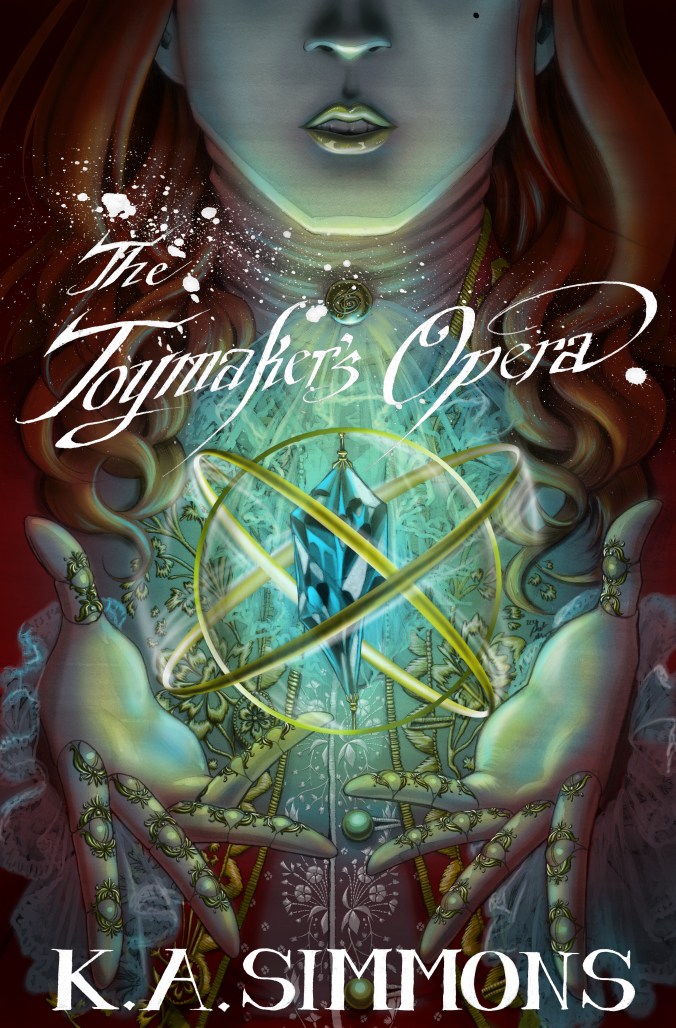
The Toymaker’s Opera is an alternative-world steampunk adventure. It is a story about a poor fortuneteller, a living automaton, a mad Baron, and a city that dreams. It is a story about the price of friendship and happiness, about legacy and talent, blood and luck. But most of all, it is a story about the things that have no price.
His Work
Jacques
With a subtle flip of his hand the gypsy made the blue stone disappear. He turned away from Jacques, ready to deposit the crying piece of crystal back among the tumble of packages behind him. “Is not for you, I think,” Captain Coleed said slowly. “Is perhaps for someone else.”
“Wait.” Jacques stood in the middle of the Solsday crowd, pressing into the stall in front of him as though he could avoid the crush of people on every side. He did not often venture out in the middle of the day, but when the gypsies unloaded at Skyman’s Wharf one did not hesitate to do business with them.
The long line of the wharf was alive with hundreds of ships that looked no different from those that sailed over the sea. White sails gleamed creamy white, like a bundled chorus of fluffy clouds. Ropes harped and sang in the wind off Stolenseam. Brilliant tiles winked in the hot sun, here at the edge of the cliff, their different designs on the hull of each ship better than a fingerprint. The tiles matched each flag that snapped at the top of the mainmasts. And not a person seemed to mind that only a few yards away lurked the edge of the quay, and a long, long fall to the valley below.
Ordinarily gypsies made their rounds to all of the major trading ports that bordered this part of the sea. Their annual journey, run like clockwork by several sets of family flotillas who left and returned at certain times during each season, spanned no fewer than three continents, fourteen distinct countries, and thousands of island archipelagos from the frozen fjords of Northern Toulene to the sun-baked city of Citta Roza. They traded with anyone and everyone, whether rights were granted to them or not; sailing through wars and political boundaries as if they were not there.
No one, no matter how prejudiced for their vagabonding and privateering past, could afford to ignore the flotilla.
Coleed–dark, handsome Coleed–wore clothes that would be the envy of any pirate. Wide, striped trousers, a wind-worn shirt, and a sharp red vest set him worlds apart from the saris, blouses, robes, bustle skirts, and waistcoats worn by the citizens of the Sheer. A bright smile, almost too white, split his brown face in two. Strands of black hair peppered heftily with silver, carelessly kept, blew into his mirthful expression with every gusting breeze.
“Jacky,” he said, using Jacques’ least favorite nickname, “Jacky, maybe you want something else, ya? Maybe one of these, I think–” From the pile of treasures behind him he pulled bolt after bolt of fine Rimsean silk, bottles of plumage from distant and colorful birds, and a whole string of Sulisine conception pearls.
There was nothing the gypsies did not carry, nothing too grand or too humble. In all his years visiting Skyman’s Wharf Jacques had seen Tamerlan golems–too crude for his taste by far–round helms from some ancient war burnished to a shine, exotic pets with two tails instead of one, and once even a child for sale–though the bid was purposefully exorbitant. Rags and the twisted ends of ship rope were often pressed at his hands by the urchin children of the ships, perhaps practice for their pushy personalities later in life.
The grandest thing Jacques had ever purchased from Coleed was an Imperial lightning engine–something invaluable to the right collector. He had taken it to task for parts; striping down the copper and strange, whirling mechanisms from the central chamber. Those pieces had ended up–directly and indirectly–inside the lampposts of a few firecats. It had been a risky move, since even he did not fully understand their physiology, but one that had paid off–with kittens.
Jacques, normally excited to peruse the wealth of foreign goods, could think of nothing but the stone. It stuck in his mind like an afterimage. He heard what he could only describe as a kind of weeping, but not sadness. Almost as though the stone wanted nothing more than to be seen.
“Please,” he said, and held out his hand. “I shan’t drop it.” And, when Coleed seemed doubtful, “I only want a closer look.”
Coleed frowned. He brought the stone around again, a big, jagged thing more akin to a chunk of raw amethyst than the basalt rock that was the bedrock of the Sheer. Perhaps he could hear it too, for he hesitated a moment too long before saying, “Take care, Jacky.” and dropping it quickly into his palm.
The world went blue.
Jacques awoke with a start. He looked up to see the concerned faces of his so-called apprentices peering at him and the comfortable four walls of his own apartment. “Hm-mm, my apologies. My work has been getting the better of me most nights; rest hasn’t come easy.” With extreme reluctance he rose out of the chair, wincing at the stiffness of his joints. He made his way over to the stove. “Tea?”
Next to him Thomasine nodded. Her cascade of crimping blonde hair kept falling into her eyes. “You weren’t asleep long.”
Tadeo, his dark Ombolan skin picking up the shine of the cold winter sun, only just suppressed a good-natured chuckle. He ducked his head when Jacques frowned at him. “Ah, as I was saying–”
“Yes, yes.” Jacques waved his hand distractedly as he filled the kettle. “This book you’re making. What did you call it, Creatures in Clockwork?”
Savoy unwrapped the oilskin seal on the papers carefully, the movement of her long fingers purposeful and without waste. “Something like that, Master Augusti. We wanted to compile all our knowledge together, including diagrams and instructions on how to fix the different automatons in the city.”
“Whatever for?” Jacques blinked at them. “If you can know it and tell it to your companions, what is the point of writing it all down?”
Never, from the start of his own odd apprenticeship, had he recorded a single detail. It all fit together in his head, the way the wind and the sea and the tide did for a ship’s captain. Making and repairing the various types of clockwork men and women had always seemed like second nature. He remembered the size of bolts, the exact thickness of copper needed for a rooftop dancer; knew the lifetime of gears by the sound they made. Jacques possessed a nearly complete mental map of all the automatons in the Sheer, though he had not named or numbered them, or kept a diary of their last repair dates.
He did not miss, either, the glance that passed around the room at his words.
“You don’t approve,” Tadeo said, flat.
Jacques shrugged. He was a master at his craft and knew it better than anyone. “A book such as that would be useless to me.” He even remembered all the parts used for Alonzo. Everything he needed for the Baron’s commission was safely tucked away in the same room in his mind, ready for whenever he should need it.
Thomasine took the pages from Savoy and smoothed them. “Not everyone has such talent,” she said gently, “and in the end we hope to publish our work, so that others might follow in our–and your–footsteps, and that the city might be kept in good repair for many generations to come.”
“As it is the lifts are falling apart, they barely work.” Savoy leaned against the display counter and crossed her arms. “If they aren’t fixed soon they’ll kill somebody.”
Jacques made to interject but Tadeo beat him to it. “That’s why we’ve come to you, Sar Augusti. We’d like your help.”
“Out of the question,” Jacques scoffed. “I’m much too busy.”
Thomasine held out the papers to him. “If you could just spare a few days. Walk around the city with us: tell us the last time you repaired which contraption, any special tools that might be needed, the best way to avoid personal injury, or internal diagrams–”
Jacques brought his fist down on the nearest bench, making his tools jump. “I don’t have time to teach you such nonsense!” he barked, unconscious for once of what Alonzo might think. “When machines fail they are repaired, it is that simple. Learn it yourself, as I did–as any apprentice does. If it does not find your meddling as tiresome as I do the city will be your greatest instructor. And another thing,” he continued, “I do not appreciate this constant begging for answers and being awakened at all hours of the night for accidents you can easily manage without my help. I am a toymaker, not the solution to every single wrench the city decides to throw at you. Grow a spine, for goodness’ sake, and leave me alone.”
Wooden silence descended on the shop. Thomasine slowly retracted her arms, bringing the papers in close to her chest.
“Is that how you really feel?” Tadeo snapped, “We are barely to be tolerated?”
Savoy’s pale face grew even paler in shock. “But it’s your work that we do,” she managed.
“I’ve had enough. Out! I have commissions to attend to, important clients to work for.” Jacques’ heart hammered in his chest. He was not a cruel man–conceited and proud, perhaps, but not cruel–and even though he found their company tiresome he did not want to discourage their work.
Despite this he felt the tension of anticipation singing in his bones. The dream had reminded him that though he had already ordered the ivory and gold for the Baron’s automaton, he had yet to find a replica of Alonzo’s stone, and he did not wish to fail.
Thomasine tried once more, as her companions made their way hastily towards the door. “Just one afternoon, then,” she begged. “Just one, with only me. At least let me accompany you to the lifts and firecats and the…the lampkillers. Please.”
“Out of the question.” Jacques shooed her out behind the others. “You’ll learn it on your own in time. No, goodbye Thomasine.”
He shut the door in her face, but gently.
Once free of them Jacques leaned against the wooden surface. It had been the correct decision, he knew that. He refused the twinge of guilt that threatened to make him rush out into the close and call them back.
“A book, hm?” he said to himself as he crossed the shop and set out the fixtures he was going to need for Alonzo’s next stage of construction. “Silly, really. You’d only get use out of the thing if people in this city would bother learning to read.”
It was Sabbatsday, the one day out of the week that Jacques closed his shop and could dedicate himself to his own tasks. He’d already wasted enough time on Thomasine’s group and he set to work on Alonzo’s feet with a will.
Each piece must fit together perfectly. The toes should be able to stretch and curl; sturdy yet beautiful. One by one the joints and bits of carved ivory met to form a greater whole.
Jacques absorbed himself in their making, constantly leaning over to steady the foot on the floor, to be certain that all the necessary points were making contact. He fretted over the ankle, turning it this way and that, trying to recall exactly how the dancers’ had been made. That repair, he recalled, had been much harder. Learning the hard way that their fingertips and soles must be coated in isoprene; chasing after those ever-moving automatons as lighting forked across the sky, filling the air with the smell of ozone.
A resounding crash wrenched Jacques from his memories. He whipped around, finally focusing on Alonzo.
The boy, his arms newly attached, held his hands up to his face in a silent gasp. His blue thoughts whizzed out a second later, shame and sorrow evident among them. On the floor lay the shards of an enamel paint pot.
Jacques sighed. “Tried to grasp something you couldn’t hold onto, I take it.” He rose and cleaned up the pieces, throwing them into the wastebin. The paint itself was a bit easier to mop up, since he had plenty of rags sitting around for just that purpose.
“It’s fine, I promise,” he added, after Alonzo would not stop apologizing. “Mistakes happen. Everything can be fixed, see?” He tapped the side of one cracked pot on the shelf beside them. “There, all clean.”
Alonzo reached out, his movements clumsy, and knocked his fingers into Jacques’ chest. Those blue eyes met his with a depth Jacques had not seen before. Alonzo’s hands moved upward, walking up Jacques’ shoulders until Alonzo was cupping his maker’s face. For a long moment he held Jacques there in silence, his place on the edge of the bench almost making them of equal height.
Jacques stared into that white face; his glance darting between the soft kidskin covering that made Alonzo look almost human and the bald ivory skull behind it. Unless one looked very closely, close enough to see that his eyebrows and lashes were tiny auburn feathers sewn on with fine silken thread, close enough to see the glitter of metal beyond his pearly teeth and living tongue, he could pass on the street for just another eccentric young nobleman. It was Jacques’ finest work, work he was not sure he could hope to duplicate.
It–no, he–for Jacques saw at last that whatever Alonzo might have been, he was now a man. A man with thoughts and feelings of his own. Not a toy and not a child; more than an automaton–a person. Albeit one made of ivory and gold.
“I suppose,” Jacques managed, suddenly truly aware that what looked out at him was a consciousness, and not just a cluster of reactionary questions. “I suppose it’s time to get you a book.”
Alonzo clapped in delight, the ivory palms of his hands clicking against each other. A wide, bright smile spread across his face.
Jacques hauled the whole bookshelf over, dragging it across the stone floor. “I’m afraid none of it is very easy reading–no, like this,” he said, turning the book rightside up in Alonzo’s hands. “Gently–gently, I said. There you go. You know your letters well-enough, read to your heart’s content.”
He returned to his workbench. Though his hands knew what they were doing Jacques found himself unable sink back into the mental quiet he needed. Perhaps it was the soft rasping of pages being turned. Perhaps it was the distorted echo of the music in the pipes, coming up to him shrill and warped out of tune. Whatever the cause he could not concentrate any longer.
“I’m going out,” Jacques said, thinking to himself that it was the first time he felt the need to announce his intentions. He shrugged into his jacket and pulled the curtain closed on Alonzo and the bookshelf. “Don’t worry, I’ll be sure to pick up a gentleman’s manual on etiquette for you.”
That was not the only reason, of course. Once outside the apartment he could feel it descend on him, the singing tension of worry. “Perhaps I will find another stone,” he murmured as he locked the shop behind him. “I shall simply have to be thorough.”
Up to the jeweler’s in the close. Jacques climbed the passage, leaning in to the incline. He started methodically, going swiftly past the violinmaker’s and the lacemaker’s, waving to the owners as he did so. Up and up until he could let himself inside the velvet silence of the shop.
“Master Augusti!” exclaimed M. Armand, a clerkish but pleasant fellow, “I did not expect you today.”
Jacques suppressed a frown. People always had the idea that they should be going out of their way to please him, whether or not he wanted it. “I’m merely browsing–no, M. Armand, please, sit down. Your health, monsieur,” he protested as the older man came wheezing around the counter.
“I don’t mind one bit,” replied the Toulene gentleman, his lingering wisps of cornsilk hair and thick glasses making his eager face appear quite like an owl’s.
Despite Jacques’ subtle protests the other man followed him around the shop as he glanced casually into the many cases of rings, necklaces, and bracelets. One sweeping look was all it took at each shelf to determine that there were no leystones present.
He let himself out, waving and smiling. Jacques hurried back down the close, concerned that he had wasted too much time already.
No leystones presented themselves at the other shops in Wrightsward, even when he asked to see their backstock. Jacques did his best to conceal his dread with a hearty show of disappointment instead, even though he knew it was unfair to take his frustration out on his colleagues.
The same was true in Medtown, in Patchwork, in Philandry, and in the many drawers owned by Jia Sung. Finally Jacques left the neighborhood entirely, climbing up on the back of the Iron Stair.
It was a rickety, iron thing, held half together by the calcification of the stone on either side and half by the pipes that ran underneath. Some sections were missing entirely and Jacques had to jump over dim, yawning gaps. He would have taken the lifts but he did not want to risk missing a single out-of-the-way shop, even here.
Rats and rat king circles, firecats and their kittens, and even one limping figure–always in shadow–followed him up, up through the Sheer.
“Away with you, William,” Jacques called over his shoulder. His voice bounced off the long drop below. A breath of cold winter air bit his cheeks one moment and a scalding jet of steam-seared air warmed them the next. Jacques shivered, even under the heavy wool of his coat.
“I’ll not visit the Reach today.” He pressed on, murmuring, “Not if I can help it.”
Days passed–or seemed to–as Jacques scoured the Sheer. He walked until he couldn’t anymore, his old feet finally growing weary and his knees protesting even one more set of stairs. When sleep threatened to overtake him he stumbled into the dazzling marble and chiffon foyers of nice hotels, sometimes finding dreamless oblivion in their beds, other times nothing but the nightmare of nutcrackers shadowing his footsteps, waiting for the exact moment he should fail.
No matter what sales each shop had, no matter how their managers pressed velvet tray after velvet tray of precious stones in his hands, Jacques insisted on going through the cases one by one. The hot light of the lamps danced on every cut and polished surface, leaving his head with a deep-seeded pain that refused to relent.
He danced in and out of pleasantries–and, once he was above the Teeth, carriages–sipping weak tea and burnt coffee. Thrice he doubled back on someone’s advice, only to eventually find himself in an alley with the rubbish heap of a diver before him, long ago disassembled by his own hand.
Through each tower Jacques searched, the dark districts that changed names in ten paces, going up and down the winding paths until he was more than just footsore. Thief children ran about him, booing softly when there was nothing to find.
Once Jacques thought he heard Alonzo calling him, but his blue voice mixed with the music in the pipes until the toymaker could not tell one from the other.
His search brought him to the Shade, but the merchants there would not serve him, for he had forgotten his business mask. The Warren brought him no relief either and they turned him away, pushing his tired frame to the border and slamming the door with no more than two words spoken.
That left Jacques with no option but two, and he knew which one he preferred. Perhaps Captain Coleed would know where he could obtain another leystone–or maybe even had one for sale–but Jacques was not now sure if he could afford the price. One stone, innocently bought, had led him to Alonzo, to having his heart carved in two. What another one would cost from the hands of a gypsy he did not care to contemplate.
For without that stone the Baron’s commission would be impossible to bring to life. The Lady Trimaris would be like a dead thing, unable to hold or possess anything resembling Alonzo’s intelligence.
Jacques stopped, his boots just shy of the brick road that marked the boundary into the Sundered Carnival. The path ahead of him was dark, unlit by lamps or firecats. No light filtered here, natural or otherwise. No, he was far too deep for that.
Something soft and squeaking bumped into his foot, and then bounced away. He heard skittering in the darkness. “H-Hello?” It did not do to enter the Carnival uninvited.
At length, after listening to the endless drip-drip of water and the distorted rattling breath of the lifts in the distance, he checked his pocketwatch. Only the hour hand could be seen and no ticking came from it. Jacques cursed himself for forgetting to wind the damned thing, very aware that he was alone on a street that was supposed to be full of people.
Suddenly a chill touched his back and the hairs on the back of his neck stood straight up. He whirled around just in time to fend off a wolfish-looking man, who stood just close enough and had somehow approached him while making no noise.
“I beg your pardon!” Jacques tried to say, but the words fell flat and would not come out. Somehow he mastered his fear, despite the eerie, phosphorous glow of the man’s yellow eyes. He slipped his watch back into his pocket, recalling the phrase his master had taught him to say.
The toymaker bowed as low as his stiff body would allow. “I seek permission to enter the place known as the Sundered Carnival and to exit again, safe and whole, exactly as I entered.”
When the yellow-eyed man spoke his voice was as hollow as an empty road, and as jagged as flint. “Seek not the crown of the Thorn King, for he is weary and full of troubles.”
“My regards to the Lord of Briars,” whispered Jacques, “long may he reign.”
The yellow-eyed man paced around him, his steps slow, calculating. “Leave off your looking for the Queen of Stones, her lands are barren, her hands empty.”
“In winter they know that summer will come again; flowers will bloom, life will out.”
“Who seeks water in a wasteland, who asks alms from those that have nothing.” He thrust his face close to Jacques’ and growled. “Who dares to walk the roads alone and expect protection?”
Jacques clenched his fists. It was a trick, a trick to get him to name himself. But he was old enough to know better. He took a deep breath, pulling on fortitude that he was not sure he had. When he spoke next he was surprised to find his voice even and unbroken by fear.
“Those without water may still offer hospitality, those with nothing may still be kind.” He met the yellow-eyed man’s gaze, inches away. “The one who walks alone offers no challenge, and is left in solitude.”
For a long moment it seemed as though the yellow-eyed man was not going to let him pass. Then he grinned, white teeth on a swarthy face, and struck a match that hissed and spat.
The light pierced Jacques’ eyes, blinding him after so much darkness. It burned white hot, like a ship’s distress flare. When he could finally see again the yellow-eyed man was gone, but there was a strange hum in his ears.
Jacques pressed himself against the wall of the tower, as far out of the way as he could manage. Faded shapes passed, paying him absolutely no notice.
The humming increased, pressing against his head in a way that had nothing to do with the Phage. It was a pressure, almost as though he was deep underwater. Jacques clutched at his head, pulling at his ears even though he knew it would do no good. Everything suddenly seemed out of focus, the world spinning and spinning until it popped.
Jacques felt the change, felt his heart give a jump as the Carnival came into view. The pressure in his head and ears disappeared, leaving his senses tingling.
A thick crowd filled the once-empty street. The faded figures had become living people, people of no shape found elsewhere in the Sheer.
Jacques set his eyes on the ground. He left the wall, moving cautiously but purposefully.
In a melting-pot city where every race and every person could find their cultural niche, there was still no place exactly like the Carnival. Creatures passed Jacques, some of them more suited to a woodland forest than a bustling metropolis. Hedgehogs and rabbits, both in waistcoats, ran about underfoot, delivering messages. Deer walked the length of the street, pulling rickshaws without handlers. It was not the animals Jacques tried to avoid however, but the others, creatures of song and story. Creatures that the rest of the world tried to pretend did not exist.
Steam hissed out into the street from the confines of a market stall to his left. From within Jacques could see the enormous, craggy silhouette of a troll, serving skewers of roasted meat to its customers.
Elves glided by, their eyes bright and their features painfully beautiful. They spared no glance for anything in their path but continued on, ignorant of the yearning looks cast their way.
There were others; ugly goblins trudging by with racks of junk strapped to their backs, maenads lying drunk under kegs of mead, dryads weeping in dark corners, sprites spending all their strength just to pickpocket one penny from the unsuspecting. Men with hollow eyes stumbled past, muttering nonsense about rivers and bridges, and bright lights. Lamplight children played in the corners, their fiery ghosts peeking out from behind barrels and doorways. Even tiny daemons scampered about, snickering as they unbuckled shoes or made off with paper lanterns.
Music filled the Carnival, music that was as haunting as it was alluring. Panpipes twittered in their high voices, weaving a melody that was as hard to ignore as the heated expressions on the satyrs that played them. Once or twice Jacques found himself going in the completely wrong direction, his footsteps tracing toward the sound of far-off laughter.
He doubled back, threading his way through a thick crowd. Even though he felt hands brush him he did not stop, did not speak to anyone. By the time he’d found the doorway he wanted a few persistent citizens were pressing him with honey cakes and glasses of elderberry wine.
Jacques was desperately hungry. His stomach snarled but he forced his hands to stay in his pockets. The door ahead opened a fraction. Jacques shouldered his way inside and shut it behind him.
He looked up to find himself in a narrow passage within the tower. The air was cooler here, similar to his own apartment. He saw no one in the hallway, only a set of steps at the end, going down.
One candle sat on a sconce by the stairs, its light flickering off the stone walls. Before Jacques had quite gotten farther than the first step the flame spoke. “Who goes there?” It was a woman’s voice.
Jacques’ head snapped to the side. From within the glow cast by the candle he could just make out the wavering form of a dark-haired girl. “I seek the Mage’s Circle.”
“Who are you?” she asked, then added, “I suppose a better question would be what do you want?”
“I have questions about implements of power, foci, if you will, and where I might obtain one. I have tried everywhere,” he lied, since he had not yet tried the Junkyard. “And no one else knows what I’m talking about. I would appreciate any information you have.”
He could see the woman looking from side to side, trying to ascertain whether he had nutcrackers with him. Finally she said, “I don’t see any harm in it.” A door appeared in the wall to his right. “Don’t take the stairs, they’ll drop you all the way into the Shade. It’s a long way down.”
Jacques nodded. These were Citadel mages, men and women who had every right to be cautious. Rumor had it that not only did the first Baron forbid their settling in the Sheer, but that his soldiers frequently conducted raids to make sure it stayed that way. Any precautions, even those that went as far as to live in the Carnival itself, could not be called too extreme.
Once inside the darkness was nearly absolute. He made his way forward, feeling his way along the wall. From a long way off Jacques saw mage lights bobbing towards him, swirling motes of brilliant green, casting cool shadows.
The same woman who had appeared in the flame now materialized out of the blackness ahead. “Who are you?” she asked, one hand at the ready. “Though bound by the Charter to do no harm to others I will have you know that I am still allowed to protect myself–and will not hesitate to do so.”
“I wish no ill will upon you.” Jacques bowed a little at the waist. “I am the toymaker, Sar Jacques Augusti. I have questions–”
She waved his words away. “You said as much. I am Susan, mage appraisee of the Citadel, seven years’ past graduation. Tonight it was my charge to guard the gate. Come, the others will know more of what you want.” Susan whirled on her heel and marched off down the corridor.
Jacques hurried to keep up. “How long has the Circle been here?” he asked, passing scratched sigils in the stone, shimmering wards illuminated by the glow of her mage lights.
“Longer than I’ve lived in the Sheer, I know that much. As for when the first members of the Circle settled? That’s up for debate, even amongst ourselves.” Susan turned her head to better speak with him, since they could not comfortably walk abreast. “Most of our earliest records were destroyed in a raid back in, oh, 1853, before the war. Back when this was still Circle’s Repast, and not the Carnival as it is now.”
“I was not aware mages had held the district for so long,” Jacques said, hurrying to keep up. His joints ached from their previous toils about the city, and here in the deep places where the moisture stayed he felt even stiffer than usual.
Susan scoffed. At the next doorway she waved her hand. Instead of a lock and key several veridian runes appeared in the air. A sphere glowed pale blue on the wood and the runes slotted into it, until they made ribbons around it. The door swung open silently and they continued on.
“The Circle will stay in the city, no matter what the Barons or the nutcrackers say.” She did not sneer, but in the rimey light her face pulled into a grimace. “Even if few are born with mage talent, they are still born, and they must still be taught to utilize their skills. It’s not a proper school, of course, but even if we can make certain that no child becomes a danger to herself–that is enough.”
Jacques bowed his head as they passed through a low opening. He did not say that it was admirable or selfless, though he well knew the Circle’s work encompassed both of those things. It must be a thankless task, but it was the duty they had chosen; much as the city had chosen him, and he had never asked to be thanked.
At length they came to a common room, bypassing a small guard alcove with a crackling fire through which Susan must have scryed him. The common room was more like one of the mercenary taverns down in Mercy’s Hall, with long benches set to the side, roaring fireplaces in each archway to keep out the cold, and one raised platform at the end piled high with scrolls and alchemical contraptions.
Men and women in equal measure paced about the room, going from one set of tables to the next. Even a few adolescents numbered among them, concentrating on spells in small groups under the tutelage of an older member. The low murmur of private conversation ceased at once as soon as Jacques crossed the threshold.
Within a heartbeat all the younger students rose and filed out of the room through dark doorways beyond, walking with quick steps and glancing back over their shoulders. A few chaperones went with them, mostly those that had been teaching.
At the head of the room the mages working at the high table did not stop their work, though Jacques caught a few furtive looks cast his way.
“What have you brought us, Susan?” asked a tall, red-haired man younger than both of them. He wore a waistcoat of seagreen, and breeches stained with occasional patches of brown. Instead of challenging his tone was soft, almost conversational, and he spoke without lowering the book in front of him.
“An outsider, Sebastian.” Susan jerked her thumb in Jacques’ direction. “Says he has questions.”
The younger–no, older–man set his book aside with a sigh. When he stood, unfolding his lanky frame from the narrow bench, Jacques could see that the mage’s eyes were as old as his own, the only hint of age in that otherwise youthful face. “Run along, I’ll see to his needs.”
He stuck his hand out for Jacques to shake. “Sebastian Way, master healer of the Salvareum.”
Jacques introduced himself, wasting little time over pleasantries. He wondered why a healer would bother associating with Citadel mages, but decided not to question it when he had more pressing matters at hand. “I have come seeking a focus stone,” he said, adding, “a powerful one.”
The healer frowned, thin lines creasing his face. Despite his apparent youth there was one permanent divot between his eyebrows that only grew deeper as they spoke. “A mage’s focus takes a great deal of time and effort to create,” replied Sebastian. “One must work with it, concentrating and meditating and transferring power, weave spells. It is not really something that can be given away.”
“There is a particular type of stone I must obtain for a commission, nothing less will do. It need not be already attuned–I do not wish to steal someone’s work from them. If, perhaps, I could see what you might have available…?” Jacques tried to treat his request lightly, even though he was in the throes of desperate urgency. He wanted to come right to it, to grab the master healer by the arms and demand any leystones he might possess. But certain rules of decorum and etiquette must be followed, just as he had done at the shops in Copperlight and the Pride and Holsgrad and Medtown, and every other business his feet could find. Jacques knew he must dance the minuet of manners, even with the shadow of the Baron hanging over him like the silhouette of a guillotine.
Despite the constant temperature inside the tower Jacques felt a cold draft seize his shoulders, remnants of a door opened somewhere far away and very hastily shut. He plunged ahead further. “Please, sar, if it would not trouble you too much? I can pay any price you ask.”
“I’ve no doubt of that.” Sebastian crossed the hall, retrieved a case after several long minutes of rummaging through papers and scrolls, and returned with it. “This is what the Circle has to offer,” he said.
Jacques’ heart sank. From under the glass many gems glinted in the orange lamplight; amethyst, rose quartz, lapis, aventurine, chunks of raw serapin amber. Nothing with that tell-tale cerulean glow, nothing with power that he could feel seething under his fingertips. “Not quite, but I will take that serapin piece there,” he said, indicating the largest. That, at least, he could work with. He received the serapin gratefully, and pocketed it with a heavy sigh.
As Sebastian made to set down the case Jacques decided he could not wait any longer. “Do you, perhaps, have any leystones instead?”
Sebastian’s head snapped up but Jacques forged ahead, ignoring the dark look the healer threw at him. “It need not be too large in size–I understand they are difficult to come by in any event–but big enough to rest comfortably in the palm of one’s hand. The cut or shape doesn’t matter, but it must be raw and unpolished–”
“Get out.” Sebastian’s clear baritone echoed in the empty hall, his voice crisp and full of frost. “Not another word,” he warned, cutting off the protest Jacques had been going to make. “You have no conception of that which you request.”
Jacques scoffed, drawing himself up until his indignation was as tall as the other man’s considerable height. “How dare you?” He had faced rudeness before–what man hadn’t?–but in the face of an honest inquiry this was altogether too much. “If you don’t have what I seek then you have only to say–”
“Out!” Sebastian demanded, stepping close enough to force Jacques back toward the entrance.
Jacques tried once more, retreating. “I can pay whatever you want–anything!” He reached for his coin purse but the healer thrust him out into the corridor.
Protective wards already crackled and hissed, making ready to reseal the Circle. “Never would I be fool enough to keep a thing such as that under my own roof. I pray that your search ends in failure,” Sebastian spat. “For your own sake.” And with one snap of his fingers the door slammed home.
Immediately the spells jumped into place and before Jacques’ very eyes the wood rippled like water, and then disappeared entirely. He blinked once and found himself out on the border of the Carnival, his feet on stone and the brick just at his heels.
The coin purse he had been going to pull out dropped to the street, musean pieces scattering everywhere in a shower of gold. Jacques cursed, oaths flying out of his mouth that he had not dared utter in decades. “Goddess’ eyes and luck be damned!” His chest heaved and his cheeks burned hot with anger. “No conception? No conception!” The toymaker stomped around in a rage, thankful for once that he was completely alone.
Whether he wanted to or not no longer matter, for there was no other option left, he had to visit the Junkyard.

