The Baron’s commission.
If you like this you can support me on Patreon.
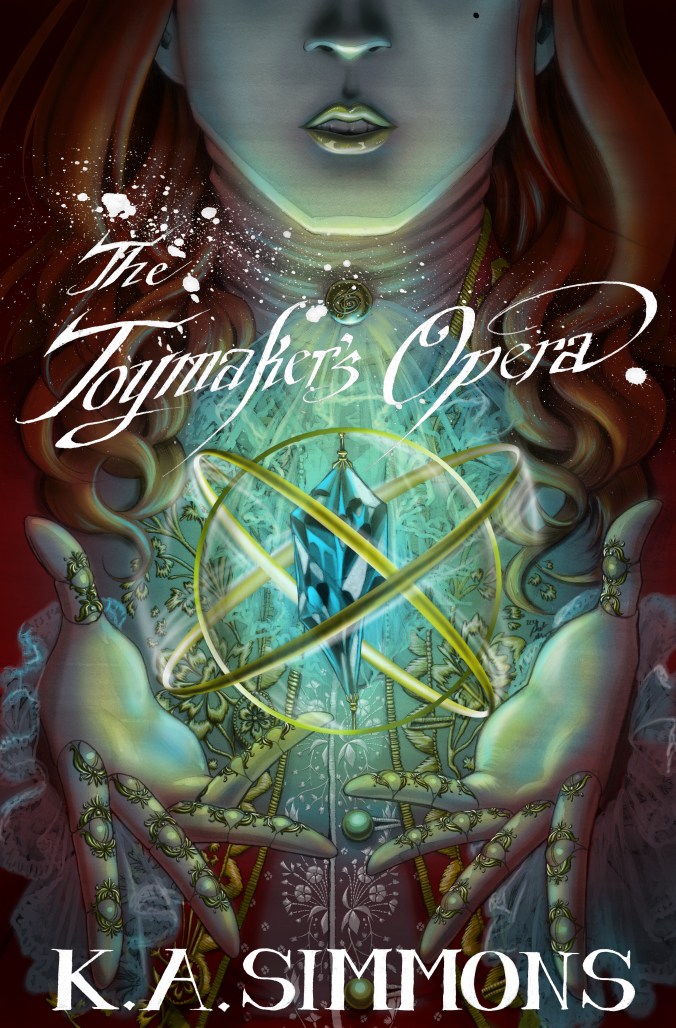
The Toymaker’s Opera is an alternative-world steampunk adventure. It is a story about a poor fortuneteller, a living automaton, a mad Baron, and a city that dreams. It is a story about the price of friendship and happiness, about legacy and talent, blood and luck. But most of all, it is a story about the things that have no price.
Enter Octavian, Stage Left
Jacques
The city stirred, its beginnings like a pebble tumbling down the face of a mountain. A lone carriage set out from Sunsgate, the mechanical driver cracking his whip overhead with the precise rhythm of a metronome until the carriage all but flew down the broad streets and through the open squares, while pedestrians scattered to keep clear of the clockwork horses’ sparking hooves. Down the city’s higher reaches the carriage wove, the automaton footmen in their red velvet coats swaying as the carriage swerved through streets that narrowed with every switchback. When at last it seemed as though the carriage could go no farther without smashing a wheel against the front steps of a townhouse, it drew to a halt before the broad, white Cendrillon Stair leading down to the Lane of Lifts.
With stiff, precise steps, the footmen dismounted, unfolding the carriage steps and pulling wide the door. Two nutcrackers emerged from the satin darkness within, polished black boots clicking on the stone underfoot, their bodies swiveling at the waist to take in the bustling crowd. One of the pair reached a gloved hand, upturned, into the carriage; with a muffled, wooden clack the Baron d’Bardi waved the gesture away with a sweep of his lacquered black cane.
He emerged from the carriage like a prowling wolf, raking the crowd with his gaze, searching, it seemed, for someone or something in particular and, as always, finding the world wanting. Down the Cendrillon Stair he stalked, flanked by his attendant nutcrackers, while behind him the carriage rolled away with a grinding of gears and a clatter of iron hooves.
Those on the Lane already in their lifts swiftly paid their toll, eager to descend. Of those waiting in line every eye now turned to the approaching baron, and for one rare moment the Lifts stilled, awaiting passengers suddenly reluctant to embark until they knew for sure which lift the Baron intended to take–if only so that they, themselves, could avoid sharing it.
Octavian made for the middle, striding across the broad square. His coattails swung, the tip of his cane clicked against the cobbles. Without making a motion to pay he stepped inside the box, nutcrackers filing after. Several more soldiers, those whose job it was to guard the lifts against any kind of vandalism, abandoned their posts and joined him.
As soon as the last nutcracker was inside and just as the sliding door had latched into place the lift plunged down. It screamed in its tracks, setting of a shower off sparks along the rail.
Bitter wind and swirling snowflakes sailed past the Baron as the lift dropped like a stone. He did not grab for a handhold, but stood fast, legs wide apart. The last dying light of day could not reach the heart of the Sheer but each level was announced by the orange glow of lanterns, and so the passage down the city made bars of light and shadow on Octavian’s grim face.
The city made way for the Baron, pulling aside the delicate dreams of those who lived in the tower just beyond the lift. It sent firecats running ahead, fetching nutcrackers broken or not to attend him upon his exit. It called for gas lamps and amberic lights to shrink down as small as they could get, no more than yellow pinpricks in the darkness.
Waterwheels shuddered and stopped, their constant roaring suddenly ceased. A wild party in the Junkyard drew to a stumbling halt, its gypsy denizens hurrying to close all access doors to their stolen district. Airship sailors at Skyman’s Wharf threw off all mooring lines and hovered at the edge of the docks, just out of reach. Thieves slunk away from shadows suddenly grown too dark and deep, retreating to the red lights of the Warren’s twisting passageways. The nine furnaces of the Faid Faran guttered and spat, their embers burning low like narrowed eyes.
Even Sophia closed her windows against the night, against the echo of many marching feet.
Many dangers awaited a citizen of the Sheer over the course of their lifetime but there was one for which no person had ever prepared: silence.
Tucked away in his cozy shop Jacques woke with a start. He struggled against blankets that were not there for a moment before he remembered that he had fallen asleep in front of the woodstove.
Warm, ruddy firelight danced across the otherwise dark room. It threw strange shapes high on the wall, glinting on pots of paint and metal tools. The light only just illuminated Alonzo, who sat where he had been placed on the far bench in the corner of the room.
With little warning the incessant blue curiosity of the boy’s thoughts interrupted Jacques’ still-sleepy ones. Alonzo pressed him with questions–at least, Jacques believed them to be questions–one right after the other, his focus shifting from Jacques himself to other items in the shop to the other pieces of his body on the workbench and finally to the hissing gramophone.
Jacques sighed, rubbing the ache out of his eyes. He had no idea what time it was. Clearly he’d forgotten to wind the clock after coming back from his shopping. By the look of things outside it was high time for dinner–among other things.
“Half a minute, you impatient thing,” he said to Alonzo, a weary smile poking at the corner of his mouth. “I’ll put on another one.” Slowly he rose from his warm spot by the fire, wincing as aching joints recalled themselves.
“Time once again for the opera’s winter season to begin, to coax the starlets and socialites down from their high castles, to mix amongst the rabble of petty musicians and aspiring ballerinas.” Jacques’ deft hands replaced one scroll with another inside the gramophone. “Let me see, surely they would be performing The Raven King tonight, a fitting start. Then, like as not, there shall be all manner of independant performances, some new, some old. And when the sun is at last beginning to strengthen once more they’ll put on The Sleeping Spring, as certain as clockwork.”
A piping question, eager for more, piqued from Alonzo’s direction. The boy searched Jacques’ face with too-blue eyes, almost as if he could compel the older man to look at him.
Jacques chuckled. “And then? Why, and then the Il Susurrus opera house will settle down for a good cleaning and painting and, most important of all, practicing, before their summer season starts. If this were some globe in a backwater frontier town I don’t wonder that they should be able to turn over their props and costumes in two weeks’ time, but those artisans up the city need longer than that to prepare for their forthcoming shows. Yes, perhaps a costume could be reused, but what if the soprano were wider of hips or shorter of build? No, not everyone is shaped the same. Not even the nutcrackers, though it would certainly make it easier to repair them and no mistake.”
Before long water simmered merrily on the stovetop as the snowflakes danced ever more feverishly outside. Jacques lit the lamps and the cheery light made the big shop seem comfortable and intimate, worlds removed from the weather on the other side of the window pane. The deep hum of cello song wound through the room from the gramophone’s speaker, adding to the atmosphere.
From his place in the corner Alonzo was abuzz with excitement. He could just barely see the pieces of ivory that Jacques had placed on a workbench, pieces that would shortly become a part of him.
“Alonzo,” Jacques said, a warning tone in his rich voice. He sensed the boy draw back and sighed. “How am I to work in peace if you are peppering me moment by moment? Here, rest now. I shall show you my progress in the morning.”
The toymaker left his workspace and swiped the hanging curtain across the partition that separated Alonzo’s bench from the rest of the room. For several long minutes he stood there, trying to shut his mind to the sudden barrage of anxious thoughts.
“A young gentleman minds his bedtime,” Jacques said and was relieved when Alonzo complied.
He made his way back to the workbench, shaking his head. The boy would have to learn to mind. Jacques knew that he was no father at heart, but at the least there must be discipline. He resolved to finish work on Alonzo’s arms as quickly as possible, so that the boy might be taught to read–and therefore be distracted for a time.
Jacques loved this strange clockwork creature of his, this boy who would be made with the body of a man. Alonzo often mouthed the words to his favorite songs, his gold-painted lips moving up and down though he had had no lungs until last week. He wanted to know everything, and Jacques was almost hesitant to provide the boy with a slate, for fear that he would start writing out his questions and never stop.
“I cannot work fast enough to suit either of us, it seems,” the toymaker murmured, not unkindly. “For you would be finished right away, and I would have you be as well, if only it didn’t mean that then you would be a man grown…” He picked up his carving tools. “…and no longer in need of me.”
If Jacques had had his way he would have begun work on the automaton’s head first, fashioning the eyes and the smile–his favorite part of each doll. Instead he had been forced to work outward from the heart, and a heart in motion at that. Once set into the golden brackets that would read the magic coming off the stone like tines on a music box, the heart whirled inside its gyroscopic rings, giving sight to otherwise lifeless eyes and motion to a spine that had had to be hastily constructed.
Jacques never overlooked a detail. Alonzo’s construction–though rushed at times–was never anything less than his best.
With the handsome yet beautiful face completed, Jacques had spent these past few weeks engrossed in the complicated work of piecing together the torso. Canvas lungs, lined and seasoned so they could expand to hold air without bursting, breathed now in easy rhythm. Several sets of intricate cams whizzed up and down on their columns, the sound of clockwork so quiet you couldn’t hear it unless you pressed your ear to his chest. These were so small that each set could sit on either side of the heart, gathering the instructions that the stone sent out and passing them along channels of conductive serapin resin to the limbs themselves.
Though assembly on Alonzo had not yet progressed below the waist, he was more alive than not already, and could twist this way and that on his golden spine. Once completed he would be able to bend and waltz just as easily as any lordling, since his chest cavity did not need to be taken up by instruction scrolls. In truth he needed very little of Jacques’ prestigious talents, only the exact knowledge of when to leave off filling him with metal and to let his natural will do the work.
Jacques peered down the core of the ivory arm. The past few nights’ work–Alonzo’s left shoulder and upper arm–gleamed at the edge of the bench, their whiteness undiminished by the yellow glow of the lamps.
Each section of the limb; forearm, hand, fingers, and so on, would be made of ivory. There was gold filigree to affix at each joint, and the pearly joints themselves to fashion. The work on the hands alone a monumental undertaking. It was nothing to the man who frequently dealt with rusted iron contraptions and champing gears, but it was delicate work nonetheless.
Jacques worked in musical silence, narrowing his whole attention to the task in front of him. The fingers must have the same range of motion as his own. They must be able to grip and clasp, to touch and caress. Jacques spared no detail, looking up only when a pounding knock at the door shattered his concentration.
“At this hour?” He frowned. “Who on earth–” Rising, he crossed the shop as quickly as he could. The moment, the exact moment it seemed, Jacques placed his hand upon the doorknob the door itself sprang open with a crash.
In filed the nutcrackers, line after line of red velvet jackets, rusty bayonets, and broken button eyes. They filled the tiny storefront of the shop, spilling out into the workroom beyond like a scarlet tide.
Jacques clawed his way through them, pushing hard against their stiff torsos. “What is the meaning of this?” he shouted, trying to be heard over the sound of their tramping feet.
As one the nutcrackers stilled, freezing between almost one breath and the next. The ones deeper into the shop made no noise, while the ones in the storefront pressed aside. Jacques suddenly found himself in an open circle in front of the door.
He faced two enormous soldiers, larger and broader than the rest. These did not have button eyes but a long strip of black cloth wound around their heads. They wore tall, furred shako hats and tattered golden epaulettes on their shoulders. Despite their somewhat shabby appearance Jacques knew they were Captains of the guard, more alert and perhaps more vicious, than their enlisted counterparts.
As one the captains presented arms, going through the motions of moving their rifles with solemn rigidity. Then they stepped aside in time, revealing none other than the Baron Octavian d’Bardi.
The Baron swept into the room, coattails fluttering. He brought with him a chill breeze, and a few wayward snowflakes that twisted and fell instantly to the ground. “Jacques Augusti, I presume?” he said, biting off each word as though it were distasteful.
“M-My Lord, I–” Jacques fumbled, unsure what to say. He was too proud to say it was an honor to be interrupted so, and at this time of night. But neither was he suicidal enough to demand that the Baron leave.
“You’ve defied my summons for far too long, Sar Augusti. I have a job for you and I will not be ignored.” He snapped his fingers.
The Baron was a tall, thin man, the way a whip was thin. He did not smile; for the arch of a sneer never quite left his brow or the edge of his mouth. Though young in appearance–his queue of brilliant scarlet hair was undampened by grey or white–Jacques knew that the Baron had ruled the Sheer long before his arrival and would certainly do so long after his death. d’Bardi had lived longer than anyone else in the Sheer, longer even than the gypsies if rumor was to be believed, and that was a long time indeed. He spoke and acted in a way that brokered no argument.
By whatever power he possessed the nutcrackers obeyed, instantly fanning out inside the workshop, four to a bench. Quite before Jacques could open his mouth to stop them, they heaved together, lifting each table clear of the floor. Others scooped up armfuls of jars–paint, beads, marbles, powders; it didn’t matter.
“Stop!” Jacques bellowed. “Stop this at once!” He rounded on the Baron. “My Lord, I will not be treated so. Tell your men to put down my things, they are delicate and require special care.”
The Baron’s lacquered cane whished through the air and came down with a sharp crack on the display case next to Jacques’ hand. Several fractures appeared in the glass but it did not break. “If you did not desire to see my nutcrackers treat your shop in such a manner then you ought to have come when I first summoned you. You will come to the Reach now, or suffer the consequences.”
Jacques snatched his hand away. He drew himself up, boiling inside. “You cannot–” he began, but stopped. The Baron could do as he liked, and they both knew it.
“Letters I sent you,” the Baron growled, ticking them off on his long fingers, “and runners. Nutcrackers and requests and appointment cards; I have tried every courteous way to obtain your services, for my need is great. And yet still my delivery boys return empty handed, but no more.”
Pain spread through Jacques’ hand as he realized his nails were digging into his palm. He shoved aside a nutcracker that was trying to get by with its arms full of delicate jeweler’s tools, preventing it from taking another step. Full of fury the toymaker faced the Baron. “I already work for you!” Jacques snapped. “I repair your broken machines, your divers and weavers and rooftop dancers. When you need a firecat’s flame rekindled or a lampkiller’s touch refined, the city calls to me. When the calliopes in your precious opera house are run down and out of time the conductors come to me. I resew the broken buttons on your nutcrackers. I make sure the lifts run on time, and it is I alone who repair the clockwork courtiers you are so fond of keeping–”
A feral snarl edged out of the Baron’s bared lips. He seized Jacques by the collar. “Wrong!” he cried, and slammed the toymaker against the cabinet. “I repair my own creatures,” the Baron hissed through clenched teeth. “Is that clear?”
Jacques’ head whirled. In the confined space at the edge of the shopfront, pressed between the display cabinets and the stone wall, almost all the light in the room was blocked by the nutcrackers. Long, deep shadows like fingers danced overhead. The Baron’s hard fingers dug into his robe, bruising the flesh by his collarbone. Jacques gasped; one nutcracker at the far end of the shop was reaching for the curtain that hid Alonzo from view.
“You…are correct, my Lord,” Jacques said, even though it was not true.
“Indeed. Now–”
“I cannot go to the Reach with you.” Jacques forged ahead, despite the light that lit the Baron’s eyes, even though there was no light to be had from this corner of the room. “All my tools are here.”
The Baron shrugged dismissively. “Those are easily transported. Your presence at the Reach is necessary; you will begin immediately.”
“You there, hands off!” Jacques shouted, motioning in the general direction of the benches. All the nutcrackers paused, including the farthest one, turning their torsos slowly to look between the man who commanded them and the man who fixed them.
Even trapped as he was Jacques knew he had only bought himself time, time he could not squander on bluster. His pride tasted hard and bitter as he swallowed it, turning to the Baron and saying in a softer tone, “Please, my Lord, every tool I own, every scrap of material, has been as well loved and treated as the toys I create. You would not hand over a master’s instrument to these fellows; I implore you to leave my shop and my things as they are, and disturb nothing. Any work you desire of me can surely be done here, and delivered to the Reach later.”
“Impossible.” The Baron’s long queue of scarlet hair stood out like a scream against the pallor of his face. From this close Jacques could see that not a single button on his waistcoat matched, and that the tailcoat was worn about the hems. d’Bardi scanned the shop with shrewd eyes and an expression like iron, perhaps evaluating Jacques’ claim. This was the man who, it was said, could shut down an entire theater–or factory–with a single displeased word.
For a moment Jacques saw his future hang in the balance of that grim expression. He saw his work and his toys and his Alonzo all gone in favor of the endless city repairs the Baron would no doubt set him to. He saw, clearly in his mind’s eye, his own shopfront closed, empty and dark.
Thoughts racing, Jacques sought desperately to appeal to the Baron’s sense of sanity. “My Lord, you might as well ask a soprano to sing in the street, or have a pianist play with cracked keys. If you would not ask it of a musician, I beg you, do not ask it of me. I am a master artificer and I know my needs. Tell me only what you wish and I can provide it to you.”
The Baron considered this, a storm of emotion neatly concealed behind his hard, dark eyes. Only the pressing of his lips into a stern line gave voice to the war that raged within. d’Bardi was not a man of gentleness, after all, but violent extremes. “Very well,” he said suddenly, dropping Jacques and resuming the sarcastic drawl for which he was also known. “I suppose I can’t risk having any less than your best.
“I want a doll–a life-sized automaton, with the capacity to be life-like in every way.”
Jacques stared, only just remembering to close his mouth. What the Baron described exactly matched the idea behind Alonzo’s construction. “Could you…be more specific?” he managed, hoping his face revealed nothing.
“Since her body cannot be made of flesh and blood,” the Baron snapped, impatient, “then it must be made of something else! I need a woman’s body, in iron or steel or brass; I don’t care–”
Jacques grasped for a response. The Baron had plenty of clockwork creatures made by his own hand who walked the Reach. Granted, they were not very life-like. In fact, one could almost call the existence of the nutcrackers and the lampkillers as cruel torture; since it was nothing like living at all. “But what for, my Lord?”
“It does not matter what I need it for,” he retorted hotly, rapping his cane against the glass. “Only that this body must be built as quickly and perfectly as you can manage.”
In his haste to grab for quill and paper Jacques nearly tripped over several nutcrackers’ boots. He stumbled behind the counter. An automaton like Alonzo but created the normal way would not be easy–or inexpensive. So much work would have to go into designing the cams and gears that would pull the limbs and contract the face. Jacques turned, pen in hand, and nearly ran right into the Baron. To his horror he saw that the man had followed him right into the workshop.
He recovered, eager now to get down as many details and get the Baron out of his house as swiftly as possible. “A female automaton, of course. Very well. And how would you like her to be run?”
“I beg your pardon?” the Baron said, raising an eyebrow.
Jacques went on quickly, waving a hand that somehow took in more than just the clockwork creations in front of them. “Scrolls of instruction, miniature cams–should she have to be wound, like some of the servants in Sunsgate are?”
“Do you still not understand? She is to be as alive as possible, as good as you or I. Or as good as you can get without flesh, anyway.” The Baron’s narrow face pulled into a tight frown. “How a man of your education could be ignorant of the theories of Landsman and Harrogate, I ask you.” He sniffed in disapproval, but made no motion to call the nutcrackers to resume their ransacking.
As usual, or so Jacques heard from those who worked in the opera house, the Baron was halfway through a complex topic without bothering to bring everyone else up to speed. “I require more detail, my Lord,” he said, pretending to keep his eyes on the paper while actually watching Alonzo’s curtain.
Now, more than ever, he willed the boy to be quiet. Let him not barrage the Baron with questions or do anything to make his presence known. Whether it was fear or confusion that kept Alonzo silent Jacques did not know, nor did he care, as long as he remained hidden. It was truly luck that the nutcracker standing there had listened in the first place, for the Baron’s next words sent a shiver down Jacques’ spine.
“My automaton will need a stone heart,” said d’Bardi, without even a glance in Jacques’ direction. “A focus, like the ones mages used to use. A…core, if you will, through which life might be viable. Something that won’t be worn by time, something to keep her safe.”
Jacques shook his head. Not because he disagreed that the Baron might need a wife–which was the only reason he could think of for this request–but because he alone knew how truly rare stones like Alonzo’s were. There was always the chance of making the heart out of serapin amber, as it was naturally conductive to magic, but Jacques had the cold, sinking feeling that that would not suit the Baron’s needs at all.
“But what will power the heart?” he asked, trying to buy time and information in the same breath. “A focus stone alone won’t be enough to–”
“I will be the judge of what is or is not powerful enough for her body!” The Baron brought his fist down on the nearest bench, making the ivory arm and fingers jump. “I am asking you to create something well within your scope of talent to do so and–hello, what in the Muse’s name is this?”
d’Bardi reached across the worktable and lifted the ivory hand before Jacques could stop him. He turned it over and over, examining the twisting gold filigree around the joints, the smooth way the fingers moved as they contracted or expanded. “This,” he murmured, “this is exquisite work.”
“That, ah, that, “ Jacques stuttered, trying to edge between the Baron and the rest of the room. “That is part of an experiment in motion and form.”
The Baron held up the hand to the light, his mouth no longer pulled taut in displeasure. “This is what I want. This is how I want her body to be made. Sturdy, yet beautiful. Why, with a pair of kidskin gloves she could easily still pick up tools or dress herself without a maid’s assistance.” His voice trailed off, growing softer as his expression did, until he more resembled a picture of melancholy rather than a mercurial child.
Jacques coaxed specifications out of him, writing down everything from the exact shade of her ebony hair to the alto pitch of her voice. He knew he could not spin miracles but by the Goddess he would certainly try.
Finally the Baron gathered himself and, setting down the ivory, made for the door. “I trust you have enough to begin, Sar Augusti,” he said briskly.
“Ah, no, my Lord.” Jacques took the opportunity to shoo the nutcrackers away from his benches, marching the last one out with a firm hand on its back. “I will need her sizes, of course; waist, shoulders, arm length. I do not wish to create a woman too petite or too large for you.” Internally he shook himself. Clearly the Baron believed that Jacques would be making a person–whole and individual–from the ground up. It seemed callous and somehow intimate to discuss such things about a creature who would be, for all intents and purposes, a member of the fairer sex.
Jacques pulled away from such thoughts, from the disgust of what might eventually be done between the Baron and the wife he would have to create. For a moment he felt he might be sick; sick from the knowledge that if he had spoken a moment too late this would be Alonzo they were discussing.
“I can have one of my men deliver the sizes to you later,” the Baron said, appearing not to notice Jacques’ sudden grey face. “As well as a painting for reference. She must look exactly like it, none of this repeating mold-work as you have done with these other dolls.” He gestured to the ones in the display cases.
The toymaker swallowed. He, too stepped into the shopfront, swiping the dividing curtain closed behind him. “Of course, I am no ametur, my Lord. You shall have what you request.”
Neither of them had to say that there was no room for failure. The last man who had failed the Baron had hung himself off the edge of the Teeth, with no way to tell if it was the nutcracker’s doing or his own. No matter how famous, no matter how wealthy or well-loved, someone might be, it was never enough to escape the Baron.
But if he did not displease d’Bardi; that was a thought. If he succeeded, where only a few opera directors and singers and violinmakers had done so, it would earn him even more renown. That was not something Jacques wanted, precisely, but presumably if the Baron was satisfied then he would leave Jacques in peace. And that was something the toymaker wanted very dearly.
“Good.” The Baron rolled the cane between his fingers. “There is also the matter of compensation. What is your price for such a request?”
Jacques balked. “Surely you would tell me your budget, my Lord. Though she will be rather expensive…”
“Done. What? You seem surprised, Sar Augusti. I do not expect a master craftsman to work for free. And spare nothing in the quality of materials. Whether you get the ivory from Rimsea or the Empire or Ombolan matters little to me; choose only the finest.”
Settling in to the more comfortable rhythm of negotiating, Jacques replied, “Then I will need an advance of no less than three thousand musean gold pieces for materials and to cover shipping costs. You can pay me for my time when the labor is complete.”
“As you wish it.” The Baron motioned to one of the nutcracker Captains. “Bring him a purse with that amount tomorrow. I’ll want you to get started right away.”
“–Once the materials arrive,” Jacques put in, relieved when the Baron accepted this without question. “And now, my Lord, it is late. I’m certain you have an opera to attend and I must make preparations to order my supplies tomorrow, when the shops are open.”
The Baron swept to the door. He stopped and looked back once more, as if he could still see the ivory hand laying alone on the workbench. “I expect,” he said with sudden coldness, “it would be too much to hope for that there is more where that hand came from? It would be so much easier, after all, if my sister’s body did not have to be made entirely from scratch.”
Just then Jacques sensed the bright blue tendril of Alonzo’s thoughts, reaching out beyond the curtain. The alien mind of the stone was made human by its fear and compassion, and its anxious question of whether Jacques had been harmed. Looking at the Baron Jacques knew that d’Bardi must sense it, even if he did not know where it came from.
“As I said, my Lord, it was merely an experiment in independent locomotion. I often get commissioned to work on orchestra calliopes.” Now Jacques was thinking fast. He stood right behind the Baron, hoping to block his way back into the workshop. “They have such delicate fingers, and it is so hard to get them to press upon the strings of a cello or the holes on a flute with just the right amount of pressure and–”
“Yes, yes. I know that.” The Baron waved his explanation away. “My men will return in the morning with everything I have promised–and you will deliver to my expectations as you have promised.”
Jacques bowed low even though he had dealt with prima donnas less demanding. He eyed the nutcrackers as they filed out. “You have my word as a master, my Lord.”
“Goodnight, Sar Augusti.” The Baron left, closing the door behind him so firmly that the windows on either side shuddered. Nutcrackers formed up in little regiments on the Baron’s heels and followed him down along the passage.
For several long minutes the only sound Jacques could hear was the unusually loud pounding of his own heartbeat. Gradually other noises came back to him; the hissing of the gramophone, the pop and crackle of the fireplace, and the gentle ticking of the clock on the wall.
The toymaker grabbed a chair usually reserved for guests and sank into it, his legs suddenly unsteady. So it was a sister the Baron wanted then, not a wife. That fact should have relieved him but how could it? A sister meant love. A sister meant family.
And that, Jacques knew, was impossible.

