In which Moira tries to settle her debt with Gray.
If you like this you can support me on Patreon.
The Toymaker’s Opera is an alternative-world steampunk adventure. It is a story about a poor fortuneteller, a living automaton, a mad Baron, and a city that dreams. It is a story about the price of friendship and happiness, about legacy and talent, blood and luck. But most of all, it is a story about the things that have no price.
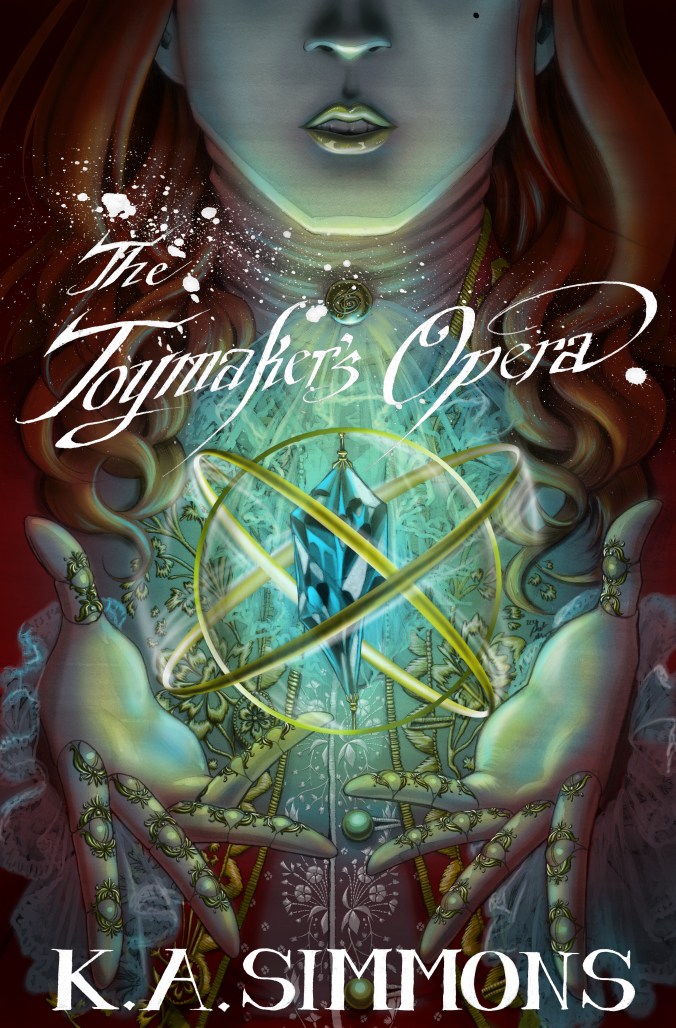
The Toymaker’s Opera
Sisters of Sun and Shadow
Moira
Frigid salt water crested the railing and crashed over Moira. The solidness of the wave broke upon her back, a moment of near-drowning, and then the rivulets were running down her arms and face, plastering her hair against unseeing eyes. Wind drove at her from every angle, sending stinging raindrops like musketfire against her skin. She splayed her feet for as much purchase as she could get on the slick wooden deck and hauled hard on the oar between her hands.
Though numbed through with cold and sea spray Moira could still feel the blooming ache between her shoulderblades and along her arms with each sweep of the oar. How many hours had gone by since the storm began she had no way to know. It might have been an afternoon gale or a full-scale typhoon; there was no way to measure time except the distant beating of the ship’s drum.
She couldn’t see the men on either side of her, either, could barely feel them at all. The only indication Moira had that she was not alone was the constant heavy jaw of the iron shackles on her bleeding wrists, snapping taut as she rowed.
Lightning crashed overhead, so bright and close that another slave cried out, though he should have saved his breath. Thunder followed almost at once, so loud it was as if a cannon had gone off right in her ear. Moira winced, for a moment able to hear nothing but a dull ringing. Then the sea and the sound of it came rushing back, and another wave smashed against the deck, this one hitting her full in the face. She staggered, footing swept out from under her.
The Rimsean slave master cracked his whip overhead, a threat readily heeded. Moira pushed and pulled in time with her fellows, desperate not to call attention to herself. Under her hands, now rough calloused and strong, the solid wood of the oar moved in great sweeping strokes, propelling the tiny galley up one giant swell and down the steep slope of another.
Despite the howl of the storm and the heartbeat of the drum, another sound cut through the booming roar of the sea. It started as a low hum, in her teeth, working its way steadily higher. Moira shook her head to clear the noise, suddenly unable to focus. The deck of the ship and the world all around her felt numb and far away. Heart pounding in her throat, she gripped the oar and hauled with all her might against the ocean’s fury.
Moira broke out of sleep screaming. She clawed the sweat-soaked blankets off and scrambled to her feet before the calm darkness of her own apartment was fully realized. Nevertheless she stood naked in the doorway to her kitchen for a long time, until the rocking of the sea and the last threads of her nightmare finally faded away.
The iron pipes that ran through the corner of her bedroom vibrated high and clear, spilling the Phage into the street outside. Mechanically Moira checked the windows and her front door, to be sure there were no cracks. There were none and she made tea, standing while the kettle heated.
“Not another one,” she murmured, leaning her clammy forehead on the cool stone of the kitchen wall. “Not another dream.”
Moira tried to remind herself that she was no oneiromancer, who could take the fabric of their clients’ dreams and use that to divine the future. She was a fortuneteller, a card reader. If her magic had something to tell her it wouldn’t use a dream, at least she thought it wouldn’t. But the sea and the slave galley had seemed all too real, and so had the nightmare about being laid out as an Ophelia, cold and unable to move, the day before, and the one of Gray delicately carving her a new face the day before that. Moira had bitten her lip, woken to the taste of blood, and nearly resolved to flee the city then and there, debt collectors be damned.
But she hadn’t. Her debt, even though it was her mother’s debt in truth, had to be settled. After her last encounter with Gray, where he had clearly meant to capture her for some further nefarious purpose, she didn’t know what to expect of the man. If she was ever to be free from her mother’s shadow, however, Moira knew she didn’t have a choice. She would have to visit Gray and soon, or risk worse retribution, whatever that might be.
In the darkness at the base the final southern tower, along the wall of the cliff, crouched the disreputable district of the Shade. Sheltered from above by the brick-paved roads of the Sundered Carnival and on either side of the tower’s corners by two enormous iron doors, the Shade was forever shrouded in impenetrable night. The cloak of blackness was only broken by the thousand dim red eyes of apartment windows along the cliff wall and the prowling forms of firecats who had wandered away from their posts.
No one knew when the Rimseans had moved in, bodily evicting the previous residents and invoking a bloody civil war with the Warren. An uneasy peace had been reached, though it had been bought with many lives, and even now both dens of thieves nipped away at each other’s heels, giving the districts in between no end of grief. They dressed their parlors in eiderdown pillows and geometrically-patterned rugs, smoking fragrant hookah and drinking strong tea like wine whenever they conducted business. A Rimsean man was as likely to be hospitable as hostile, depending on his mood; they made up for their immobile faces by changing allies, promises, and contracts whenever it suited them. In fact, if it hadn’t been for the strength of their coin and deep pockets, they might never have been allowed to stay in the first place. But despite the uncertain date of their arrival, since each section of the Sheer preferred to ignore the others until inconvenience arose, there could be no doubt the Rimseans held the district now, and held it well.
Rimsea; a jeweled city-state where men wore masks instead of faces, where the sun and the sea beat down upon the land like a master to his slave, where a noble woman might find herself with as much wealth as a soprano and a gypsy would find his life just as mean, a city with secret places and a law as unforgiving as those that the nutcrackers enforced. A city of cruelty and beauty who was only oustripped in ruthlessness by the Sheer herself, a city who might be called the Sheer’s southern sister, if it were not for the fact that neither would admit to any similarities between them at all.
Moira scoffed as she carefully counted out her coins several days later, after the Phage had ended. Surely the Rimseans were more lazy than the men and women who worked in the Sheer; she could hardly remember noticing any of them doing any sort of manual labor. And if their lackadaisical attitude wasn’t enough, the time they did spend working was all towards smuggling, drug running, and slave trading. They were a nasty business, every one of them, even if a few of their race did prefer to start shops instead like civilized folk.
“There, six srir and eighteen cassum pennies.” Moira slid the coins out of her hand and into the nutcracker’s collection box.
A silver rattle followed and then a click as it slowly closed the lid. The single nutcracker, who had attempted to undercharge her again, lingered on the stoop.
Moira made a gentle shooing motion. “Go on,” she said, not unkindly. As much as she would have liked to pay less, and as much as she had the suspicion that the automaton was trying to give her a discount out of charity, she couldn’t let that happen. “The others will come, do you understand?” she continued, when it seemed the nutcracker would not move. “Your fellows will know and I will have to pay it all later, at once. Thank you, though, for doing it the first time.”
The nutcracker could not bow, at least not very well, but it made a valiant attempt with a sound like a creaking hinge. It then turned and marched stiffly down the steps and away, the tramping of boots fading into the hubbub coming up from Wrightsward below.
Attempting to quell her rising panic, Moira stepped out onto the landing and locked the door behind her. She secured the key and her funds and then stood in place, trying to unknot the tangle of lead that was her stomach. Finally, after several deeps breaths had done nothing to ease the tightening pang of worry in her chest, she made up her mind and set off, heading for the Lane of Lifts.
“Damn Margarette,” Moira muttered, cursing her mother’s name. “Damn her.”
It was no longer a matter of choice, for the consequences would soon fall at her doorstep if she abstained; she had to see Gray.
Once divided up between necessities such as new candles, food, firewood, soap, fabric, salt, and tithe, and saving forward for the few luxuries she would allow herself–a proper bath, tea, a second-hand blouse, and a new stone to further augment her readings–only half of what she owed Gray remained. She hoped that Gray would consider an even half better than nothing, and let her go, but there was no way to be certain.
If only her mother hadn’t been such an empty-headed fool! Moira bit her lip as she stepped inside the lift and winced as the door slid closed with a rattling screech of iron. There was nothing to grab onto, except the automaton at the back of the box.
The lifts traveled the tall length of the Sheer, going from Sunsgate to the Junkyard, cutting through every level. Each box was fenced on all sides by metal grating, much like a cage, so that the riders would not tumble out and be broken upon the bottom of the shaft. Yet despite this precaution the lifts were anything but comfortable and many folk avoided them out of habit; as they did not always go where one told them to.
Moira edged toward the denseness at the end of the box and slipped a few spare coins into the change slot. “Mercy’s Hall, please.”
Like a calliope the mechanism slowly shuddered to life, the vibration rising until the automaton’s arms began to turn the crank that would take them down. Moira grabbed onto the change reservoir with a cry as the lift sank like a stone, too fast. If she reached for any of the box’s bars she ran the risk of her fingers being shorn clean off by the support beams passing them by. She held on, swaying when each level jolted the car.
“Oh muses,” Moira moaned softly, the wind of their fall blowing her hair into her face and tossing her skirts all about. Beside her the automaton cranked still faster: a thin tune, worn down by centuries of service, playing quintuple time all the while.
When they landed at last Moira staggered out, determined to walk back to Medtown, even if it took her all day. There had been no way she was going to traipse all the way down to the Shade with so much money on her and taking the lift, however terrifying, was the quickest route. On the journey home, however–if there was a journey home–money wouldn’t matter.
Moira adjusted her clothes, patted her pockets, and set out. She was on the very lowest level of the Sheer, where it was as cold as a night in autumn. No sunlight filtered here, or if it did, she could not feel it.
The avenues at the base of the towers were spacious and deserted. If she were to travel directly east, toward the cliffside, eventually she would meet up with the market district of the Pride, the bank where she had exchanged her musean gold piece for a pile of srir coins instead, and the glittering bathhouse of the Troi Matabla. The far-off cacophony of a thousand voices at market could not penetrate the dark towers, and the air around Mercy’s Hall was silent and still.
Moira shivered, feeling the openness of the broad avenue on either side of her, sensing not even a firecat, much less any person. She walked, conscious of the dull clipping sound that her boots made on the stone, echoing back larger and louder, as if she was a regiment marching and not one woman alone.
The street took her west to another intersection and farther, past the open doors of mercenary halls where bawdy men and women called to her in appreciative and cajoling voices. South for the length of a tower and a half, crossing the lamplight of skymen’s taverns and the leaping firelight of ringing forges. Moira kept on until her feet ached, trying not to think of what–who–she was about to face. She nodded to passing strangers and kept her chin up and only once had to slap away the ghosting fingers of a pickpocket, who did not try again. She walked and walked and ignored the false flattery that poured out of tavern windows until at last she came to the great iron door that was the entrance to the Shade.
The door itself, she knew, was to keep the nutcrackers out; the Rimseans preferred to keep their own culture and their own laws separate from the rest of the Sheer when at all possible. Why the nutcrackers had not interfered with the doors’ making was a mystery, since any other ghetto that tried the same was quickly put to rout. Even now, as she leaned in to speak to the gatekeeper, she could sense a swirl of denseness off by the massive hinges; where the nutcrackers gathered with tools to try to take the door apart. They did not work very fast and occasionally shuddered and gave a queer wooden cry as rifle shots were fired at them from secret places along the wall. But despite all the trouble the Rimseans threw at them the nutcrackers did not stop, and if their tools were destroyed or stolen, they only went away and returned later with more.
It was a hopeless endeavor, one the Rimseans could not mean to win. Yet they had held off the Baron’s soldiers for more than a century, a feat no other district could lay claim to. The laws of the Sheer were as rigid and unyielding as the stone of the towers themselves, save for those rare few, it seemed, who were clever enough to avoid them.
Moira bit down on her prejudices as she was hastily admitted into the Shade, the smaller door of the gate inside the larger one that spanned the street clanging shut behind her. The boulevard she had left behind had been nearly deserted but here, inside the Shade, the road was teeming with life.
The spicey scent of sizzling meat wafted through the open market, mingling with the smell of chalky dyes and heady perfumes. Voices called out on either side of her, merchants crying the value of their wares in the sing-song language of their native tongue. Moira threaded her way between the thick knots of crowd, trying not to let her hands jump to her pockets and show off where she was keeping her money.
A blue-hot pinpoint of light, five times the height of a man, appeared at the very edge of her second sight. Moira pushed through the throng and flattened herself against the cold stone of the cliff, as far out of the way as she could manage. Slowly and sedately, as if it had all the time in the world, the light came on. A soft clicking accompanied it, the sound of delicately-hoofed feet navigating the uneven street.
Just as the Sheer had her firecats, machinations of the first Baron, so did Rimsea and the Shade have the stiltwalkers. But whereas the firecats had been created through a mix of sorcery and mechanical artificing, the stiltwalkers were creatures of nature, though not native to this side of the sea. Moira remembered them, vaguely, from childhood: deer-like beings with glossy coats of silver-blue, eyes glowing white and phosphorous, thin legs covered in a horn like glass, and fine, branching racks of antlers, upon which hung hundreds of lanterns. They served the same purpose as the firecats; streetlamps.
Moira stayed away from them all the same, though they were well-known for their even tempers and were not vicious in the least. The market around her was for locals, not outsiders, and there were few Rimseans who would not try to pick a fight with a faceless stranger. She bowed her head and hurried away from the lamplight that the stiltwalker brought, desperate not to be accosted before she reached her destination.
A journey that should have wound her in a maze of hours was instead made short by memory. Ordinarily trying to find any one door on the wall of a cliff that was populated by thousands of doors and jutting roofs and interconnected staircases was almost impossible but Margarette–damn her–had led Moira too often to Gray’s parlor to beg for Hex, and so now the fortuneteller found her way without error, though that fact made her anything but happy.
Moira stopped short on a broad patio, breathing hard from the climb. She pressed her hands together to stop their shaking, jumping them away at once as her fingers touched the memory of rough callouses. Before her stood the looming doorway to the Ocient, Gray’s hideaway, four guards lounging at their leisure beside it. Now that she was here and they had seen her, there was no leaving, however desperately that she might wish to.
The guards laughed to one another, jeers directed at Moira, near as she could tell. One of them rose and came forward, his lilting, accented voice full of false courtesy. Clearly they remembered her. “Sweet shade to you,” the man said, bowing too low. “However may we be of assistance to such a fine lady?”
Moira bristled, the dream-taste of salt water rising on her worry and disappearing in her anger. She had come to pay Gray but not to be mocked. “I have business with Gray,” she snapped, “bring me to him at once.”
“Of course.” The man purred his words until they sounded less given to exaggeration and more like the hissing of a snake. He snapped a command to the others and they sprang up at once, rising from their table of dice and going to open the door to the Ocient. “If you will come this way.”
It was not a question and Moira walked forward, conscious of their gazes. She could not run now. To go pell mell down the side of the cliff would be asking for a broken neck, if she was not caught first.
The air inside the cave house was cooler than the air in the Shade, if that was possible. Moira was paraded down a narrow tunnel, only able to tell its size from the scuffling of her footsteps echoing back to her. The tunnel turned and twisted, curving back on itself. She remembered being blindfolded as a child, clutching tightly to her mother’s sweating palm, as they were led together. There was no telling how many other openings they passed or whether she was being taken in circles for the humor of it. Whatever bristling she had felt died away, settling down to a heavy dread that made her breakfast feel like an uncertain stone in the pit of her stomach.
Gray’s men brought her to a low couch in a wider room and bid her to sit and enjoy herself while they fetched their master. The first man who had spoken to her went away and came back presently with a tea tray. He set it before her on the rug and made a show of explaining the sweets he had brought to accompany the beverage.
“Candied lemon birds,” he said, pressing the dessert into her hands before she could protest. Delicately folded, the dried strip of lemon preserves had been formed into the shape of a hummingbird, wings outspread, and dusted with fine sugar.
Moira balked, quickly closing her fists, but too late. The man had managed to put a sweet in one palm and a cup of strong tea in the other. “I can’t, no, thank you,” she blundered, realization dawning.
This was one of the ways Gray had ensnared her mother, offering Margarette material comforts and rich food and a bed in which to sleep undisturbed; something Moira realized now that her mother, too hungry and gone with Hex, could not have refused. Margarette might have declined, though, once she understood what was happening or she might have decided not to return to the Ocient, but she had not, preferring to throw herself at Gray’s hospitality if only it would mean more Hex. And it was that constant return that compounded her debt, Gray running up Margarette’s tab for every single scrap of luxury, every cup of tea, every morsel of food, every pillow on her lended bed.
The high, sweet smell of lemon and the light tang of molasses from the sugar was almost too much to bear. He’d already handed it to her, after all. Despite her nerves Moira’s appetite snarled in protest.
Trembling a little she set the lemon bird and the tea cup back on the tray at her feet and then clasped her hands before Gray’s man could put anything else into them. “No, thank you,” she said when he tried to press her further. “I am quite full.”
“I am not a dream-seer,” she murmured once he’d gone away, disgruntled but no less courteous. The words felt flat in her mouth, empty reassurances. Perhaps the nightmares were only in warning, a caution to keep her head.
As the minutes ticked by Moira lost all track of time. The men had left her quite alone in the large room and here there were no pipes or voices outside or even a breath of wind to mark the hours. Everything seemed to funnel to a single point–her eventual conversation with Gray. Beyond that discussion Moira could only envision darkness, could foresee no plans of reading that night or what groceries she needed to purchase next. The outcome of her visit to the Shade could only be one thing; but whether she would need to run or fight or beg was not yet clear.
Moira swallowed her anxieties, or tried to. She forced herself to mentally retrace the steps that would take her out of the Shade and back to Medtown. A hundred routes presented themselves, several handy ones crossed out because they led through the Warren and Moira had no desire to go looking for further trouble. The possibility of a quick escape route would take her down the last lift into the Junkyard, or up to the Ream, where she might lose Gray’s men among the factories there. She could make for the safety of the Crossroads Clock–surely they would not be so stupid as to follow her then–but that would mean running for the better part of the day out along the cliff’s edge itself, a prospect that did not endear itself to anyone. Moira chewed her lip. Her best bet was to get out of the Ocient if she could and throw herself at the mercy of someone else’s front door, and hope it did not also belong to Gray.
“–I told you, Corto, that is no way to treat a guest. Honestly, treating Sa Mim as though she were just any visitor! You ought to be ashamed,” Gray said, sweeping into the room, entourage in tow. He strode up to Moira and bowed low before her. “My deepest apologies for my associate’s behavior–trying to press you; absolutely unthinkable, what a wretch–it won’t happen again.”
“Canus–” Corto, the guard who had tried to give Moira the sweets, began.
Gray made a gesture Moira could only hear by the rasp of linen, a quick cut of his arm. The guard closed his mouth on whatever else he had been going to say. Gray took the opportunity of silence to have stool drawn over. He sat upon it, leaning in to wring Moira’s hand in enthusiastic greeting. “It is so delightful to have you with us again, my dear. What an age it has been since we last spoke–but you are not here for pleasantries, of course–how rude I am–you told Little you wanted to talk business so here we are. Trust me, my dear, you have my full attention.”
“Gray,” Corto–or Little–hissed. His aggravation was not disguised by the resonance induced by his mask. “But she tried to–”
Moira, aware that her open-mouthed staring must make her look like a gaping fish, pressed her lips into a thin frown instead. Anger, malice, patronizing, elitism, cold disdain; she had expected all of these emotions. The one thing she had not expected was kindness, if Gray was to be taken at face value. She was much more inclined to trust Corto, who clearly did not like her or the fact that she had threatened to remove Gray’s mask several months ago. At least he, she felt, was acting as he ought, and not playing games.
“Yes, what about that, Gray?” Moira cocked her head in his direction and tried to keep an even tone. If he wanted to dance then she could oblige him. “You did bring your men afterwards–”
“A simple overreaction on my part. Moira, dearest,” he murmured, rising from his stool to sit by her side. Gray picked up her hands and patted them gently. “I put you in a delicate position–the equivalent of trying to take your face away would be robbing you of your cards, I expect–and you retaliated in kind. I completely understand. I only regret,” he added, truly sounding morose, “that I had not the coolest of tempers. It was wrong of me to come after you so, very bad. I shall never do it again. You must understand, however, that a debt so long gone unpaid can only be a hardship to me. I have associates to provide for, tribute to pay, Saints to honor, and guests to please. Surely you can appreciate my position. How would you feel if a customer of yours did not pay you after you had gone to all the trouble of helping them?”
Inwardly, Moira recoiled. Gray was right and he was apologizing, even if she wished that he would not sit quite so close. She could not quite forgive what he had done, however. He was a man grown, more than used to the perils of living in a foreign city, and not an apprentice first setting foot in the Sheer. No, Moira could not doubt that Gray’s attack outside her door had been as deliberate and as calculated as the honey he was plying her with now.
“I’ve come with half your payment,” she said, continuing the dance. As long as he was going to be polite then she would step in time, if it meant leaving the Ocient with her freedom and her life.
“Splendid!” Gray nearly knocked the couch over as he sprang to his feet. Real delight echoed in his voice. He called for the collections box and his tally sheet. Once these were brought he held it steady while Moira carefully and slowly counted out each srir coin.
Moira took out her pocket once she had emptied all her secret places. The little bag had traveled safe and unmolested all the way down to the Shade. She stood across from Gray, placing each coin onto the velvet lining one at a time. With every clink of silver she felt a bit lighter; closer to leaving the Ocient and closer to leaving the bad taste of her mother’s memory behind for good.
She had almost finished, the last handful of coins clutched loosely in her hand, when Gray said, “By my reckoning that should leave you with three musean left. Now, I realize you are a very busy woman and can’t always make your payments on time. I propose a reasonable schedule, due two weeks after tithe each month, of six srir at an interest rate of twenty-nine percent–”
“What.” Moira’s hand froze over the box. Her entire body staggered, as though she’d been slapped. She shook her head, not sure she had heard him correctly. “Did you say…three musean?”
“But of course, my dear,” Gray answered, sounding perplexed that she should think otherwise. “Interest for the time I wasn’t being paid, aggravation, damages, lost business, etcetera. Now, if you’ll just sign this repayment agreement, we can–”
“And what if I refuse?” she demanded. Everything she had just given him amounted to more than she would normally make in three years. And at that rate of interest and schedule, repayment would be impossible. Moira’s fist clenched, the pointed sides of the srirs digging into her palm.
He chuckled, a low, self-satisfied sound. “Oh Moira, all the charges are quite valid. You may have a lawyer look over the contract. If you can afford one, that is.”
Never in her whole life had she so much wanted to strangle someone. The rage slammed into her faster and harder and with more force than a wave at sea. It was so unfair! “How DARE you?” she cried.
Instead of striking him she threw the rest of the coins at his feet, the soft thumping of silver hitting carpet and the singing when they rolled out over bare stone. Moira turned on her heel and stormed out the way she had come, too angry to speak.
Gray’s booming laugh followed her all the way out.
~~~
Loving it? Hating it? Questions? Leave your feedback in the comments below! I can’t wait to hear from you. Please consider supporting me on Patreon so I can post more often.

