A visit to the gypsies of the Junkyard does not go exactly as Jacques expects.
If you like this you can support me on Patreon.
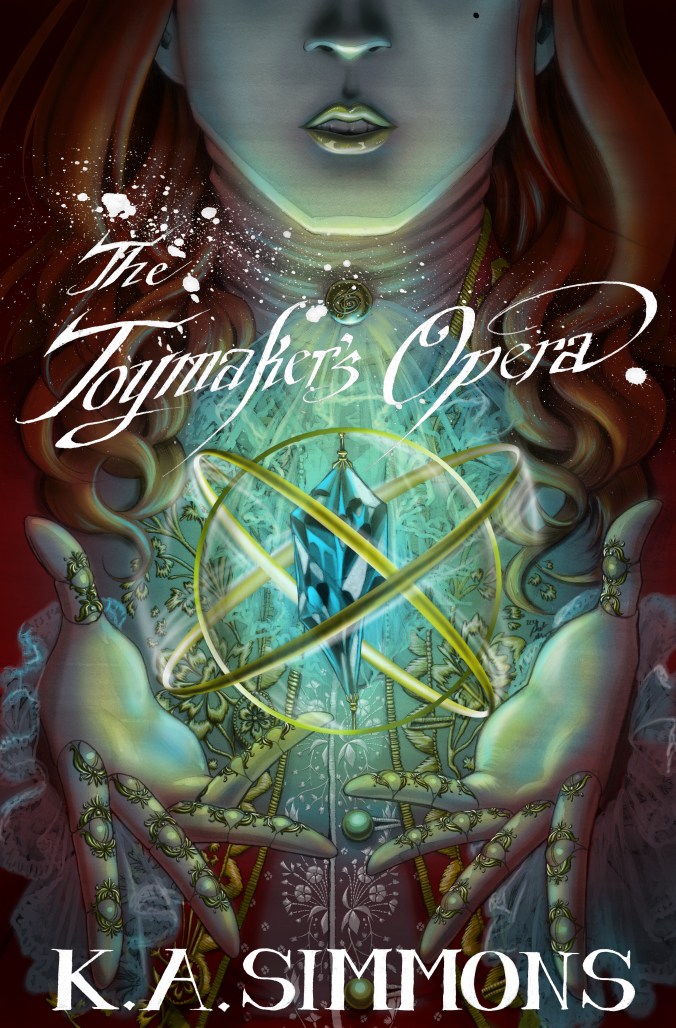
The Toymaker’s Opera is an alternative-world steampunk adventure. It is a story about a poor fortuneteller, a living automaton, a mad Baron, and a city that dreams. It is a story about the price of friendship and happiness, about legacy and talent, blood and luck. But most of all, it is a story about the things that have no price.
The People of the Sun
Jacques
On Ramsday the sun rose uncovered and shone its naked light upon the city of the Sheer. Though the air was brisk the warm beams filtered down through the districts, casting long shadows and chasing away the coming cold.
Jacques clung to a rusted handlebar on the side of the lift as it jostled its way down the wire. It had passed the Tammy and the factories in the Ream already, making a slower-than-usual descent.
The lifts traveled the tall length of the Sheer, going from Sunsgate to the Junkyard, cutting through every level. Each box was fenced in on all sides by metal grating, much like a cage, so that the riders would not tumble out and be broken upon the bottom of the shaft. Yet despite this precaution the lifts were anything but comfortable and many folk avoided them out of habit; as they did not always go where one told them to.
With a sudden jerk the lift halted. The grate door screeched open to admit several factory workers, their striped trousers and faded vests stained with soot and sweat. They filed in, each carefully placing a half penny into the coin box by the automaton at the back.
“Coffinrow,” said the first man, giving the name of the housing district they all shared.
The lift rattled to life once more and the automaton began cranking his wheel, even stiffer than before. Instead of the downward direction, this time the lift wound its way up ponderously.
Jacques suppressed a sigh. He made a polite nod to the workmen and tried to squeeze himself as small as possible without getting too close to the bars.
He thought back to how Alonzo–anxious, worried Alonzo–had begged him not to go out again. Once returned from his exhausting journey through the Sheer Jacques had thrown himself upon his bed and not risen for anything. Still, as soon as he could stand and force food into himself, he promised he would go at once and with haste to the Junkyard.
That was when the painting had arrived.
Baron d’Bardi wanted to be certain Jacques missed no detail in recreating his sister. Instead of merely providing the toymaker with a locket or a marble bust–though he had done both of those things as well since–he also sent down an enormous full-sized portrait.
The nutcrackers who brought it hammered loudly on the door, demanding entrance.
Jacques admitted them with a frown, an expression mostly made to conceal his worry. After all, the Baron had no idea Jacques needed a leystone. But Jacques made to hide his concern anyway, lest it be taken for hesitation. He would still do everything he could to complete Lady Trimaris, and he held in his back pocket one last avenue for success, yet untried.
With more delicacy that even Jacques had thought they possessed the nutcrackers carried the painting inside and placed it up against a bare wall at the rear of the shop, away from the light of the windows. Then they filed out once more, only leaving yet another heavily-laden coinpurse filled to bursting with musean gold.
There were two people in the portrait, one half-covered by a black sheet. Jacques cleared the cloth away and stepped back to take it all in.
On the right stood a handsome woman, her green eyes full of laughter and intelligence. A small smile poked at corner of her mouth. She was as pale as the moon, her upswept hair raven-dark and falling in perfect wisps around her face. Her dress, the older bustle-style that was still favored among the ladies of Sunsgate, appeared perfectly molded to her frame in shades of deep basil and pine. Despite her similarities to the Baron–the shape of her brow and nose, for one–the Lady Timaris was clearly of a different sort. Her presence almost reached through the painting, calm but joyful, and she held herself with steadfast certainty.
When Jacques checked the purse he found exactly what he thought would be there; a set of dress measurements–and requirements for fabric–that would help more than anything with his construction of the actual body. It also seemed as though the Baron would prefer his sister delivered in particular clothing as well, leaving no room for interpretation on how she should be dressed.
Curious as to who she posed with, Jacques turned his attention to the left. Instead of the image of Baron d’Bardi that Jacques expected to see, he was treated instead to the countenance of a man that he recognized–the face of Alecto Marquette. He did not recognize Baron Marquette because of a previous painting, but rather because of the single lone statue that stood, rusted and worn away by time, in the main plaza in Sunsgate. That, and there was an intensity in the man’s eyes that was impossible to forget.
Jacques stopped his fingers just short of the canvas. Here was the man who had made all the clockwork creatures that the toymaker worked so hard to keep functioning. Here was the man who had built the Sheer, who had raised up a city out of nothing.
Somehow the statue had always given Jacques the impression that the first Baron must have been a stoic figure, someone as hard as granite and just as unyielding. But here, seeing this face, that simply could not be true.
Certainly Baron Marquette was a strong man, his tall impressive figure and broad shoulders spoke to that. But he was not like the rock of the Sheer, not like the mountain, the larger-than-life shadow that hung over the city’s making. No, this close, there was no denying Marquette’s absolute, burning vitality.
His eyes stared out a Jacques with all the intensity of a blacksmith’s forge. Unyielding? Yes, but in an entirely different way.
As Jacques examined the Baron he realized with a start that the painting had not been finished. Whoever had been commissioned to complete the portrait had left a gaping hole on the Baron’s breast.
“–gusti? Master Augusti?”
Jacques pulled himself out of his reverie, away from the memory of the Baron’s expression–driven and full of scorching purpose.
The lift had stopped and the workmen all filed out except one, a young lad. “Thankee, Master,” he said, touching his cap. “‘M sister works in th’ Ream an’ she’s awful grateful fir th’ Weaver ye did the fixin’ fir.”
Taken aback Jacques only murmured, “It was nothing, only my duty.”
“Thankee all th’ same, Master. Naught other woud’ve done it.”
Jacques knew that wasn’t true. Tadeo and his companions would do more, also, if he hadn’t scared them off from their work.
Not too soon the toymaker found himself alone again. He paid the lift toll once more, to remind it of his destination, and hung on as it chugged away.
The nine nameless towers ended at the broad, empty avenues of Mercy’s Hall, and there the lifts stopped too. All but one.
One lift continued down, down to the Junkyard. As the cold, shadowed street passed Jacques’ head he entered an old mining shaft. The tight, confined space made the rattle and clanking of the lift echo back on itself in a deafening cacophony.
Jacques held his breath without meaning to. He had lived most of his life in the closes of Wrightsward but somehow the presence and weight of the rock all around him gave him pause. The handle was cold under his palm as he clenched his fist, fighting the sudden urge to turn around and pay enough toll to take him up, up to Sunsgate and the open sky.
Finally the lift emerged into an opening in the rock, a cave before him and a crevasse behind, going down into the gloomy darkness to who-knew-where. The cage stopped with a jerk and rattled open. Jacques practically shoved the door aside and scrambled out, too concerned about physical freedom to worry about his dignity.
Though he knew he was under a teeming city the silence underground was muffling and absolute. Here, the sun was all but a memory and the wind could not venture.
Not all the towers ended in flat streets of bedrock, some continued on into the deep, their last roads made out of iron grating. So it was with Bedlam’s Rest to the north and the Spire to the south. And beneath those districts the crevices of the towers came down, too narrow for streets, but just wide enough for the people of the Junkyard to string their nets across that space–ready to catch anything that might fall through.
Jacques stared at the cave before him, willing his aching eyes to adjust. Three tunnels spread out; one for each cardinal direction that was not the northern lift entrance from which he had just come. As he stepped forward a lamp sprang to life overhead–not a kerosene one or one powered by amberic means, either–but a small yellow sunstone, just bright enough to give him something to go by.
What he had thought were shadows at the edges of the cave became heaps of forgotten rubbish. Chair legs, twisted metal contraptions, broken glass, severed lengths of rope, faded tapestries and dry-rotted reams of cloth, even the cast away arms and torsos of automatons littered the piles. The longer he looked the more Jacques began to see sense in the randomness, to see the degrees of decay. It hurt his eyes, however, to strain them so, and he soon turned away.
He chose the middle tunnel and walked on, keeping one hand always on the wall.
There is no darkness like darkness underground. Try as one might the eyes cannot adjust. The hoped-for light or sense of sight does not come. Any instinct of direction disappears, crowded out by the solidness of the rock. Even the ability to tell–as if by a cat’s whisker–the placement of another person or object, evaporates completely.
Unlike superstitious folk Jacques did not ascribe any human qualities to the dark. It did not menace him or press upon him. Yet he picked his way through the inky blackness carefully, like a blindfolded horse fording a raging river, going forward whether he wanted to or not.
Once, a long time ago Jacques had been Verandi. He shared the gypsies’ race; their blood and their Goddess, but he had since rejected their vagabonding and carefree ways in favor of a settled life in the Sheer. Though he himself had been born on the sun-scorched isle of Verana, deep in the steaming jungle, Jacques did not truly consider himself Verandi. Not for him was the lackadaisical work ethic that characterized the rest of his people, the shirking of duty and slinking about with palms outstretched. Come what may Jacques conducted himself as a Sar–a Sheer-born gentleman–and not a gypsy Don.
Exactly how the gypsies had come by the Junkyard as their home in the first place he did not know. It did not suit them. The Verandi were people of fire and passion, not of darkness and the cold chill of abandoned mining tunnels.
“All the foresight to make your orders up front but too distracted to bring a lamp, I ask you,” he chided himself softly.
A loud squeal of metal made him jump right out of his skin. Jacques only had time to throw a hand up over his face before a beam of light shone directly on him, dazzling after an hour of blackness.
“What you want?” demanded a fierce-looking woman with bright eyes and a coal-streaked face. She held the lantern up high–a patented firedamp lantern, he realized–trying to keep him off his guard. Strangers did not simply wander in the Junkyard, no matter what their purpose. Likely there were sentries posted at each entrance to the central camp.
Jacques gathered himself. “I wish to see Captain Coleed.”
She crossed her arms, every bit as obstinate as a precocious child. “He no live here.” Many Verandi did not receive any form of formal education, and their parents steadfastly steered them away from any charity schoolrooms. It was well-known that gypsies prided themselves on not being able to read a lick of Tameric, Toulene, or any other civilized language, even if they could chatter it amongst themselves like birds.
Jacques knew better. Perhaps not all of them but a few–for the Verandi culture was an oral one, founded on traditions of myth and storytelling–could read and write, even if they professed that they could not. Some like the Captain went to great trouble to enact not being able to read business contracts, squinting at the pages and asking for them to be read aloud, and then refusing to sign anything when the lies and underhanded clauses were not also recited verbatim.
The woman in front of Jacques had a thick accent–so thick it was likely she only spoke Verandi at home–but he knew she was not stupid. Only the speech pattern of her native tongue translated into his made it seem that way.
“I come alone,” Jacques said, speaking with care all the same. “This is no raid. I have business with the Captain.” He flipped her a coin.
She snatched it out of the air, its silver arc suddenly stopped. The glare of the lamp lowered and then Jacques could see that she was of mothering age, though probably childless all the same. She chewed on the side of the coin, to make certain it was not tin. Her gaze swept him up and down, calculating.
“You come,” she said finally, “but no trouble.”
Jacques agreed and the gypsy woman took the lead, taking him deeper into the twisting maze. Tunnel openings passed that Jacques had not noticed before, not even a draught of air to distinguish them.
The labyrinth wound back upon itself so many times that Jacques began to suspect he was intentionally being led astray. Just as he gathered breath to say so, the path ended abruptly in an enormous central cavern. The woman left him without a word, pointing only down the ramp to the entrance before disappearing back the way they had come.
A long road circled the broad room–so broad he could not quite see the other side–twisting up past the entrances to living quarters or other exits. Staircases cut up through the ramp, leading to yet more houses. Anytime a stair met the ramp it crossed under, with a bridge of study wooden slats directing visitors ever downward. Useful, since any raiding party trying to take over the district might think twice of dropping down to the stairs for fear of breaking an ankle. The ramp road–likely used by mining carts back when the bedrock was delved for coal–made an excellent funneling point.
Jacques proceeded down. He had never been in the Junkyard before and since there was no one with him to comment on the rudeness, he gazed openly at the camp before him.
The cavern was circular, its far wall disappearing into darkness and its bottom floor worn almost smooth. Lanterns and tents spiraled out from a central bonfire, the hot coals and ashy grey logs visible even from here. Buckets of water stood by it, some sudsy and leftover from washing, others made murky by dishes cleaned. It was a dangerous thing to have an open flame so deep in the tunnels but tradition–or preference–demanded one, and so the gypsies took every care possible to line their avenues with firedamp lanterns, in the hope that bad air could be noticed before it reached the center of the camp.
Tawny and warm, the jolly notes of a fiddle reached Jacques’ discerning ear. Rather than the restrained playing of a violinist, or the passion of melancholy many violinists attempted to achieve, this music was altogether different. The sound wound up out of the camp, joined by reed pipes, tambourines, drums, and a chorus of many boisterous voices all singing together. This was not music made by orchestra or committee, but rather by community.
Jacques shook his head, though the tune felt familiar in a way he couldn’t quite identify.
The smell of roasting meat and savory spices filled the air of the cavern, rising in heady clouds of steam and smoke from the openings in multi-colored tents. From the lights within Jacques could see–and hear–children shouting, more lively in their games than any child in the city above would be. He caught glimpses of love-making between the flaps, and turned his gaze away at once in embarrassment.
It was morning–just after dawn prayer–and the people in the camp moved with purpose about their daily tasks, most already begun. A knot of men at the far end shifted through a pile of debris, sorting the cloth, wood, and metal into separate piles. Women gathered at a thin river channel that cut through the cavern to do laundry, though it was impossible to tell whether washing or gossip was more important than the other. Young folk repaired sails or twisted rope, looking industrious and bent to their task–the exact opposite of the bored noblemen’s sons Jacques sometimes saw above the Teeth.
The junk, in fact, was everywhere. Spoons and scraps of cloth good for nothing else made pinwheels and charms against evil outside each tent. Pieced-together engines spluttered along, making boilers or cookstoves hot, each stranger and more bulky than the last. The wooden arms of nutcracker men received new coats of varnish and were fastened to lampposts, lanterns clutched tightly in their hands.
In one clearing a man clad in a thick leather apron and gloves broke cracked pottery upon a stone, scraping up the dust into a slip filled with water. Farther on, a woman molded tiles from a second slip. Another painted the tiles while a fat kiln roared beside her. That wasn’t all, for Jacques spied one mother–a babe fastened firmly to her breast–stitching cloth of a similar color together to make signal flags. One youth very carefully twisted lengths of frayed thread into one another, creating a new spool of many hues. Forges hidden in low sheds at the back of the cavern melted iron scraps, and the constant ringing of hammers spoke clearly to their repurposing.
At the bottom of the ramp Jacques drew up short. A palisade of rusting bayonets fenced off the path from the rest of the camp, save for one gate.
Outside the gate sat only one guard, a barrel-chested man smoking a pipe. He was a mountain unto himself, wide in the shoulders and square of face. A short cropping of salt and pepper hair crested his head, and he rumbled a greeting that sounded like stones. “Sweet sun, Jakka.”
“Sweet sun, Boris,” Jacques replied, wincing a bit at the use of his birth name. He was not Verandi, would never be Verandi. The sooner this was all over, the sooner he could begin work on Lady Trimaris, and not mingle with people far beneath his station. “I’ve come to see Captain Coleed.”
Boris, unlike the women chattering away by the river, was a man of few words. He chewed on his pipe thoughtfully, his coal black eyes taking their time to look Jacques up and down. While not quite as dark as an Ombolan, Boris’ skin was deeply tanned and lined by many years working the deck of the Sun Queen. He pulled around his pouch of sk’ovi tobacco, filled his pipe with it, and struck a match on the floor of the cavern. Only after he had taken several deep draws on his pipe and wreathed his head in blue-tinged smoke did he offer some to Jacques.
“Ah, no thank you.” Jacques persisted. “It’s rather urgent, Don Boris, I would appreciate…”
Boris seemed determined to move as slow as possible, as if nothing in the world could hurry him along. He tucked away the tobacco pouch and then turned his hand over to reveal a set of loaded dice. “We play a game, yah?” he said, and though he shook his palm in Jacques’ direction the dice barely moved.
Jacques flicked his wrist and a coin fell into his hand. He tossed it to Brois. “I am in no mood for delays,” he snapped, drawing his face into a hard mask. “Get me the Captain.”
Just as deftly as the woman had done, Boris snatched the coin out of the air. He chewed on the edge thoughtfully. Though it was dark, his sharp black eyes missed nothing. At length he turned in his seat and spoke quietly to someone behind the gate.
It wasn’t long before Captain Coleed appeared, his bare chest glistening with sweat and a rakish grin on his face. He pulled at his chin, his dark features only making him appear more mischievous. Not quite as lanky as his younger brother, Rashka, Coleed gave off an air of assured confidence and easy familiarity. Though clearly a man of good-natured temperament his short goatee and angular face only served to make him look more of a kin to the large camp fox trotting beside him than to any white man of the Sheer.
Coleed combed his callused fingers through his mop of silvering black hair and grinned wide at the sight of Jacques. “Jacky!” he shouted in delight, and swept Jacques into a crushing embrace before the other could say a word.
Jacques struggled to extricate himself from Coleed’s arms, from the rough kisses of greeting the Captain kept planting on his cheeks. He pushed, finally, against Coleed’s well-muscled chest with one hand and against the excited barking fox with the other. As he did so his fingers brushed against the glowing sunstone pendant that hung around the Captain’s neck.
“Muses be damned, get your blasted beast off me!” Jacques turned his knee to the jumping creature and it pranced away, yipping and jittering at his discomfort.
Coleed clapped Jacques firmly on the shoulders and kissed him once more before holding him at arms’ length. “Been too long since I last see you, eh? Too busy to visit you old captain–”
Jacques held himself stiffly, so that there could be no doubt that he would not engage in such a familiar manner. “You weren’t my captain, you just happened to be in charge of the ship I chartered in order to get off Verana. And I saw you two years ago–”
“–all this time I be so worried. You no visit, you no say ‘Coleed, how is you wife?’; no nothing,” Coleed continued, scolding Jacques as if he was a smothering dowager and the toymaker an unruly child. “We Verandi, we stick together like family, yah?”
The fox, a creature of the jungle variety with a thin wagging tail and yellow eyes, leaned heavily against Jacques’ leg. Its rust-red fur came away in soft clumps on his trousers and drool dripped from its panting mouth, oozing all over his polished leather shoes.
Disgust prickled up and down Jacques’ shoulders. He drew himself with a jerk out of Coleed’s grasp and away from the fox. It overbalanced and fell to the ground with a huff of surprise.
Jacques hardened his resolve, biting back the words he wanted to say. Despite what they might think he was not family, he was not a friend, and he was certainly not Verandi. The sharp musk and tang of just-finished sex rolling off Coleed only added to Jacques’ revulsion.
“I’ve…come for business only,” he said, though it required an effort.
Not appearing to notice Jacques’ discomfort Coleed clapped his hands in excitement and then spread them wide. His white grin revealed almost perfect teeth. “Anything for you, Jacky,” he said, using a nickname that Jacques hated.
The fox, thankfully, retreated to Boris’ side. It leaned against him and received much-wanted scratches in return. Even though neither of them watched the conversation directly, Jacques could not have been more aware of his audience. He would not have to choose his words quite as carefully as he had to the guard of the Sundered Carnival, but even gypsies had their rules.
“It’s only a trifle that I need, hardly worth your notice. When you sift through the leavings of the Sheer I’m certain you wouldn’t be able to find a use for it.” Jacques began the verbal dance softly.
Coleed shrugged. “We collect many things, yah? Make new stuff out of old. If Verandi no have use for it, why keep it?”
“To sell,” Jacques parried, “like with the lightning engine you sold me all those years ago.”
“Jacky wants a rare thing, then,” Coleed said, skipping ahead a few steps as though such a deduction was effortless. “Jacky want something he can’t find up in the Sheer.”
Jacques struggled to keep up. He opened his mouth to reply but Coleed began to pace around him.
“All over the city Jacky goes, up to the gate of the sun and down into the dark places.” The Captain’s jovial expression tightened around his eyes, and though he kept his smile in place it became sharper. “People say he looking for something, people say the Baron ask him to find it.”
Here Coleed stopped, just behind Jacques and too close. “I think maybe he won’t find it, this thing he wants. I think maybe he won’t come to the Junkyard, maybe he too smart. Maybe he know better.”
Jacques turned, taken aback by the harshness in Coleed’s normally cheerful voice. “You know what I’m after, then,” he said despite the frown that greeted him.
“I no have it–”
“Please,” Jacques begged. “I only need one. It need not be polished or cut or worked in any way. Just a raw leystone, no more than an inch across, that’s all I ask.”
Coleed shook his head. The cold in the cavern was suddenly palpable. “No. I no want to give you one in the first place. Now you working for the Baron,” he growled, and spat to the side. “If I did have one–and I do not–I would no give it to you. Jacky stop looking here; there are no more.”
“Wait, what?” Jacques pulled his coat tighter around his frame, unable to gain any warmth from the lamp nearby. “What do you mean, there are no more?”
“All gone,” Coleed said, adding, “If we find one we take it up, wrap it in silk inside many iron barrels and pop!” He made a gesture of letting go, opening his fingers wide. “We drop them into the sea.”
Anger and horror flushed Jacques’ face at once. “You what?” he cried.
Coleed made the sign of the Goddess, moving his hand in a clockwise motion in front of his breast. Shadows reached up and made the lines on his face longer, settling in the crows’ feet around his eyes and the laugh lines by his mouth.
Jacques felt a chasm of dread yawning underneath him. If he couldn’t find another leystone for Lady Trimaris she would not have nearly the same capabilities for consciousness as Alonzo. “But, surely the mine they came from would still sell–”
“We collapse it,” Coleed said, flat. “After the war. That place…” He shuddered. “Bad luck to everybody. Bad air make many people sick, die, others never get better. Land sick from runoff, coal refineries. Fish and animals all die. Mine is very bad place, Jacky, forbidden.”
Jacques waved this away. “All coal mines are dangerous–why else use the firedamp lamps?” He gestured to the brass cylinder that hung over the gate. Any place processing coal would be bound to destroy the land around it; that was simply the way of industry. But what did coal have to do the leystones?
“No, no.” Coleed reached out his hand and rested it on the head of the fox, who had slunk over to lean quietly against his side. “We find the blue stones inside the mine, deep down where men can’t go.” With a start Jacques realized he meant white men, at the same time that Coleed said, “Deep down, where we find the Phage.”
The Phage did not affect Verandi, but it could make them sick after prolonged exposure, especially if they were very young or very old. And who better to go digging in tight, cramped spaces than young children, eager to help their fathers earn money.
Boris rumbled to life. “Before the flotillas, when the Sheer was young pup, and Baron Marquette rule the city, my people work in those mines. We work for our keep–for land on the peninsula–but he treat us like slaves.” He shrugged his enormous shoulders. “Is story for another time. But after war, when the Baron is dead, we go back and collapse the mine. No more bad luck, no more pain, no more pups dying of Phage,” he finished with a growl that sounded like iron.
“But the stone you sold me?” Jacques asked, even though all the hairs on the back of his neck stood up at once.
“You stone we find by accident, ready to take out to sea.” Boris shifted and then stood up, unfolding himself. He was even bigger than Jacques remembered, and his craggy face pulled into a grimace. “You go. Now.”
“Is there nowhere I can–”
Coleed gripped Jacques’s arm, fingers biting through the coat and bruising the flesh underneath. “Jacky is smart, yah? He know when to stop asking dangerous questions.”
Jacques swallowed hard. He relented and allowed Coleed to march him back through the darkness–this time without the aid of a light–to the lift at the entrance. As he walked his mind raced, scouring his vast store of knowledge for alternatives. Serapin amber, a large enough chunk of it, might be conductive enough to serve the Baron’s purpose. At least, all Jacques could do was hope, even if he knew it couldn’t work.
They reached the cave with the lift and Coleed stepped back, leaving Jacques alone. When the toymaker turned he was just in time to see an enormous blast door, a heavy iron thing with isoprene runners on all sides to keep out the Phage, slam shut behind him.

