In the Sheer all things have a price. All things, without exception. Or so Moira believes.
If you like this you can support me on Patreon.
The Toymaker’s Opera is an alternative-world steampunk adventure. It is a story about a poor fortuneteller, a living automaton, a mad Baron, and a city that dreams. It is a story about the price of friendship and happiness, about legacy and talent, blood and luck. But most of all, it is a story about the things that have no price.
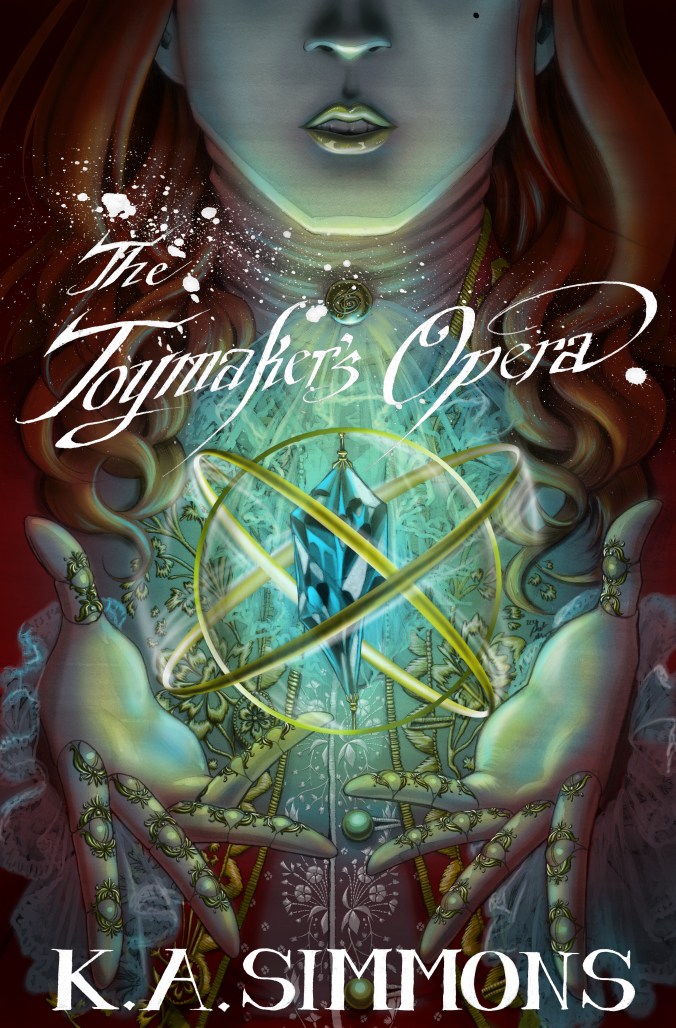
The Toymaker’s Opera
Charity
Moira
True sleep proved elusive. In the dark alcove of her old bedroom Moira tossed and turned. She twisted among the sweat-soaked sheets and cried out in fever. Warm hands–too hot hands–tried to comfort her, but she pushed them away, failing only when exhaustion demanded it.
In her dreams Moira ran. She ran from the Phage through a maze of pitch-black tunnels, passing dead miners and broken lamps. She hurtled through the rough clouds of a storm, running on air along the jagged spines of lightning. It wasn’t always the fog chasing her; a song she did not want to hear snapped at her heels, a song that was magic and madness and command all in one.
Build me a city.
“No!” she cried, sitting bolt-upright in bed.
Arms caught her. “I’ve got you, it’s all right.” A woman’s face swam into view–not Sophia’s–pale like the moon, kinder, perhaps, soft in the places that Sophia was sharp. Her hair, as dark as a raven’s wing, was swept back into a sleeping braid.
Moira cast around, taking in the velvet bed curtains, the sleepily popping fireplace on the western wall. This wasn’t her bedroom. “But I–”
The woman touched Moira’s forehead, brushing a lock of hair out of her eyes. “It’s only a dream,” she murmured. Her movement produced a phosphorous glow of cerulean blue that hurt to look at and took too long to fade. “Go back to sleep.”
“A dream?” Moira asked, uncertain. But even as the question left her lips the room and the woman slipped away, to be replaced by her own bed and Sophia.
Sophia frowned at the wall, cradling Moira in her arms. She rocked gently back and forth, eyes red-rimmed and sagging with fatigue. It didn’t appear as though she had spoken; her lips pressed into a grim line.
“I’m here,” Moira said, or tried to. The moment she drew breath the coughing fit started. An ache deep in her throat that she hadn’t noticed sprang alive, constricting like a lash every time she heaved for air. Moira buried her head in Sophia’s breast, feeling the arms around her tighten. She coughed and coughed, tasting blood and the foul acridness of the coating the Phage had left behind in her lungs.
“Well?” Coleed met Sophia at the door when she was finally coaxed to leave Moira’s side.
The fit had subsided into a deep fever that left Moira unimaginably weak; even opening her eyes seemed like a titanic effort. The others’ voices hummed pleasantly in the background, a reminder that she was not alone. Moira looked up, the shapes in her room distorted, blurry and strange. She saw Sophia silhouetted in the doorway, the straight line of her shoulders bowed to weariness.
Sophia’s eyes, a dull scarlet instead of their normal brown from the recent use of blood magic, flicked across to the bed. “We will know soon enough,” she said, “if she holds through the worst of it, then…”
Then what? But Moira sank back beneath the uneasy blankets of not-sleep and heard nothing more.
This time she dreamed she was the Sheer. The water wheels turned inside her ribs, shuddering along. Rivers roared as they poured into the Tammy, adding to the rumble of the boilers at her hips and the furious maw of the furnaces as they scorched her from the inside out. Moira felt thousands of people moving along her walkways and bridges made of metal bones. She sat, frozen and helpless, as thieves and assassins went about their work. She heard each scream, each echo of musket fire as the nutcrackers brought order, each whispered plea from the dying, the slaves, the desperate, and the unlucky.
A pain she had initially ignored clamored for attention. It reared in her heart, drowning out the small sensations of joy; mothers crooning to their babes, a junior alto receiving her first ovation. The feeling hardly had a name; it seared against her sides, lashing whips of blue at her second sight until she could hardly see; it gnawed on the back of her skull; it threshed, bursting through every fiber of her being until she could not feel the city, could not feel even herself.
It was the song that brought her back, the soaring notes of a violin’s solo, and the urgent whisper of a woman’s voice in her ear.
Moira woke to the sound of rushing rain. She opened her eyes and then immediately wished she hadn’t. The room swirled in a rush of dizzying shapes and colors. She closed them again and felt all over her face with her free hand.
Whatever fever had captured her must have broken, for she sensed no heat on her brow, only a clamminess to her skin where the sweat had dried. Moira pinched her cheeks and slapped herself lightly. The pain arrived, stinging, and faded. She waited, counting the minutes under her breath until she was sure it wasn’t a dream; she could see.
Instead of the joy she had always thought would accompany such a healing, Moira caught herself chewing on her nail beds. She pulled her hand away from her mouth, took a steadying breath, and looked again.
The alcove room was almost as she remembered it from her childhood. A thin straw tick mattress sat in a sturdy wooden frame, the headboard expertly carved by a Verandi craftsman into an image of the Goddess’ nine-pointed sun. Moira drew her finger along the lines, lines smoothed by her own hand. The room, only a few paces across at its largest point, held few decorations. Anything that she might have once kept here had long since been removed to her own apartment.
Even though the room had been sculpted out of inner side of the tower, there was a little natural light seeping in. Moira rose and cast about until she found it; a mirror high up on the wall, reflecting a silver glow from an opening above the doorway. She stared at it for some time, wondering if the mirror had been a new addition. It was not a detail she remembered.
Sight; so suddenly taken after many days of delirious fever in her youth and so abruptly returned after–after…
Moira opened her right hand. She struggled to make out the finer details, her eyes markedly weak after so many years of darkness, but there could be no doubt: the stone was still there.
But that was ridiculous. “It must have been Sophia, she called a healer, surely.” Even to her own ears the words sounded false. What would the point have been, to call a healer now, instead of when she was nine? And more; if Sophia had recruited a healer or medicker physician, that meant Moira’s debt to her–once for turning her luck and again for saving her life–had increased twofold.
Moira’s empty stomach lurched to life, snarling suddenly out of its leaden sleep. She threw her hands in the air. What was the point of wondering when she could just as easily go down the stairs and ask? Moira took a few steps forward, aiming for the blurry bulk of the door, and immediately whacked her shoulder into the wall.
She closed her eyes again–clearly they were not yet to be relied upon–waited until her sense of up and down settled, and felt her way out into the hall.
“Good morning, Sa Moira,” rumbled a man’s deep voice to her left.
“G-Good morning,” she replied, somewhat taken aback. “Whom am I addressing?”
The pungent sweetness of sk’ovi tobacco smoke reached her as the gypsy let out a chuckle that sounded more like the undercurrent of a lion’s roar. “I am Boris, of course. Sophia say we take turns watching you. Today is my turn.”
“Yes, I remember you. Thank you,” Moira added. She risked a peek, making sure to steady herself on the iron railing first.
The experiment proved to be a mistake at once. Moira barely had the opportunity to pick Boris’ figure out from the wall–a mountain of a man more suited to a strong-arm competition than tending a sickbed–before the riot of colors he wore proved to be too much. A jacket of reds hung across his absurdly broad shoulders; carmine, scarlet, claret, rust, apple, and brick; some patches too new–or too faded–for her unaccustomed eyes to make sense of it all. She had a vague impression of a quilted waistcoat underneath in tones of gold and summer’s butter, but quickly retreated into darkness again to save herself from being sick.
“He-ay!” called up the cheerful voice of Coleed, Rashka’s older brother. He must have come into the atrium from the kitchen, looking up at them from the base of the spiral staircase below. “She is awake, eh?”
“Ha,” Boris replied, taking out his tobacco pouch with a hush of leather.
Moira descended the familiar steps without incident, waving off Rashka and Coleed as they came towards her. “I’m fine,” she lied. “Is So–”
“Mon nyara!” A spiral of washed-out crimson proceeded Sophia by mere seconds. The older woman threw her arms around Moira, holding her so tight it seemed she would never let go.
Words–words that Sophia would not give voice–crackled and broke in Moira’s second sight. She saw them, felt the love in the strength of Sophia’s squeeze, the weighted cloak of worry that dragged on her shoulders. But most of all she saw the lines–blazing brightly through the blackness–the stain of recent blood magic on Sophia’s wrists.
Moira bit her lip. She wanted to let go, to let free that last bit of tension in her shoulders and let her Keeper hold her. She ached to give in, to say she had tried and that independence wasn’t worth the hand the Sheer had dealt her.
And yet.
Moira drew away. She drew out of the embrace, disentangling herself from arms that still reached. Moira stood tall and said, all in a rush before she could reconsider, “How much?”
Sophia froze. “What?”
“How much do I owe you?” Moira fought to keep her voice level, to keep things professional. She was grateful, of course, but no longer a child–
Sophia slapped her; the blow landing square across her left cheek.
It hit like lightning, a reeling strike of sudden pain followed immediately by a prickling ache. Moira staggered, catching the railing just in time not to sprawl to the floor. “Sophia, what–”
“Get out,” Sophia spat, venom sharpening each syllable. “How dare you ask me that, after everything I have done for you. You have too much of your mother in you after all–”
Moira regained her balance, cheeks glowing hot. “I do not,” she retorted, sensing rather than seeing that the men had backed a healthy distance away. “Anyone in the Sheer would have asked the same–”
“–spill my blood for you, clothe you, feed you, care for you and for what? ‘Anyone in the Sheer’, indeed! We Verandi–”
Moira raised her voice, yelling to be heard over Sophia’s commanding alto. “Which, in case you failed to notice, I am not!” She gestured, tapping her own pale skin. “I’m not Verandi and I’m not a gypsy and in case you haven’t noticed my ass of a mother left me with a mountain of debt.”
“Pah, your debt!” Sophia snarled. “It is all you ever think about! Do you have a price beside family and love in that ledgerbook of yours?”
“–family I don’t fucking have, Sophia!” They were both screaming now, nearly head to head. “If you had to endure half of what I’ve had to, just to keep living–”
“And damn your foolish pride!” Sophia grabbed her by the arm and marched her straight to the door. One shove from behind saw Moira scampering down the steps to the street.
Cold rain soaked her through at once, so chilling it doused her inner fire and snuffed whatever she had been going to say. “Sophia, wait–”
“No,” the other woman said, flat, in a tone that brokered no argument. “I will collect when the time is right, you can be sure of that. As for the rest–pah!–what I have given you, you stupid, hateful child, has and never has had, a price that could be named by any man. Now get out of my sight.” And with that she slammed the door in Moira’s face, leaving her alone and shivering in the alley.
“I guess that could have gone better,” Moira muttered. She turned and walked away, holding her arms close to her chest for what little warmth they would offer. “But how can Sophia just act like my debt means nothing?” She shook her head in disbelief and then bowed it against the rain, beginning the long trudge back to her apartment.
Of course everything had a price. Sophia ought to know that, at least. That was the law of the Sheer, and of Rimsea if Gray was anything to go by. She ought to have known that that would be among Moira’s first questions, to know if there was some healing hall that might demand yet more money. How was Moira to know that Sophia had meant the care as a gift?
Gift; the word stuck in Moira’s throat. There were no gifts on the Sheer, no charity. Maybe people who hadn’t been born here would never understand. It wasn’t in their blood to know; the selfishness of the nine nameless towers and the unforgiving people who inhabited them. Moira would have to find a way to repay Sophia, to even the scale. Somehow.
At least that answered the question of whether Sophia had hired a healer; clearly she had not, or her anger would not have been so great. That left only two queries. One, when and what would Sophia require for payment, and two, if it hadn’t been a physician who had given Moira back her sight–then what or who had?
Moira deposited the stone on her kitchen counter, glaring at it as if it would suddenly regurgitate the explanation she was looking for. She gave up, going about her chores; making certain that none of the food had spoiled while she was out. Even this little activity proved too much and, after she had hung up her clothes to dry by the roaring woodstove, Moira sank to sit on the floor, a mug of steaming tea in her hands. The fever had left her weaker than she first thought and only an effort of will propelled her into making dinner. All the while the stone sat where she had placed it, unmoving, though she kept turning her head to be sure.
Occasionally old artifacts surfaced in the favors Moira received for reading or in the market stalls around the city. Most times they were useless, like the golem she had sold Jia, or sealed tight. Raw magic was rare. This was not the Citadel, where spells could be woven into pots to keep them from tarnishing or into pipes to keep the water warm. No, the Sheer was a city run by machines and men and the broken pieces of both. It had no use for mages or their eccentric sorceries and so it saw fewer of them.
There was, to Moira, a distinct difference between her readings and the spells that mages cast. Unlike those pretentious wizards she could not raise an invisible barrier to ward off thieves or bottle pure power into aetheric engines and gems. She could not call on the elements; could not twist a ring of fire out of thin air or freeze the surface on a rain barrell in high summer. No, her magic was more instinct than not, the ability to see the truth in people and places and conductive items like her cards. In that way Moira knew her talent was closer to what the Verandi did, who shared enough innate power between them to allow their ships to fly and–she supposed–keep them immune to the Phage.
The difference wasn’t simply that she was using her magic wrong, that she could be a mage if she wanted; use had nothing to do with it. A fire mage might heal a little if he knew the technique well enough. Plenty of people born with magic fell into a niche, especially those cursed with an elemental alignment, yet were able to still craft spells outside their circle of natural familiarity. If one listened to the preachers at temple, at least two schools of philosophy on magic could be heard; that power was pure and it was the person who chose to do good or evil with it, and that some types of magic were inherently of the darkness. Moira, never having gone to temple or school, ascribed to neither side: use, she knew, was only half the puzzle.
Across the earth there roamed hundreds of people, perhaps thousands, with natural magic turning in their blood. That attunement allowed them to create spells from their own reserves and change the world around them in some way, whether great or small, elemental or not.
But not the Sheer. The Sheer had not produced a mage of significant caliber since Lady Setheria, who had floated the Teeth into position after the War of the Flotilla Fortuna, and held them in place by the strength of her will alone until the last bolt was hammered home. Since the war, hundreds of years gone, not a child had been born with talent enough to levitate so much as full-grown man, nevermind several tons of jagged iron. Those who did have a magical gift, like Moira, saw it occur in small ways like her second sight.
Whether due to the frosty nature between their countries or something else entirely, only a few enterprising mages from Merule and the Citadel made their home in the Sheer. Those that did soon left, never staying long, whatever their reasons.
Moira did not read cards that night, nor the night following. When she picked up the Sangrine their golden light frothed between her hands, reeling away from her touch. She set them down, unable to bear looking at them.
Her second sight and her eyes fought over the shape of things. More than once she ran into the wall or banged her elbow on the kitchen counter. The absolute blackness of night, which had never bothered her before, suddenly became a nuisance and blessing all in one. If she wanted to sew then she wanted light, but if she had light then the fanciful prints on the flour sacks made her ill. She wanted to patch holes that she had never noticed in her paper lantern and to polish her shoes. Moira wondered if the world would ever look as it had when she was a child, perfect and in focus, or if she would have to spend the rest of her life half-seeing. There was little point going to a healer when she couldn’t afford one–could never have afforded one, even without the burden of her mother’s debt.
When she finally made the choice to buy candles–to brighten her reading room as well as give her a light to practice her sight by–she prepared for the shopping trip by tying a strip of wool across her eyes. The world shuttered to comfortable darkness once more. Of course it would look silly to anyone who knew her, but she did not trust herself to keep her eyes closed while there were so many new things and people to see.
Superstition ruled in Medtown, and if anyone had seen her leave Sophia’s or noticed her returned sight–which they surely would the moment she opened her eyes and began to track the movements around her–they would doubtless start a wildfire of rumor that she would be unable to put out. People talked and when they did it could add up to a dozen reasons not to visit her, “She’s cursed, touched by her Keeper’s practice.” or “Has her sight again does she? Wonder what the girl had to pay to get it? You know that Gray fellow’s been coming around…”
Moira shut her ears to the jabbering voices in her mind. But the fact remained that she could show no one, not even Tabitha, who was about as native to Medtown as it was possible to be and still have a Wharite accent. Customers would be different, of course, once her cards started to behave. Customers wouldn’t know her or her past, they might even be willing to pay more when she could look them in the eye.
The late evening crowd pressed in on either side of Moira until she was able to slip into the seer’s market, where the path cleared a little. “Beeswax candles, please,” she said to the chandler behind the stall.
He bobbed, his singular, cheery glow of personality doing the same. “Right away, Sa Moira.”
She took the candles, wrapped tightly in their paper, and hurried back towards home. Mist billowed up from far below and water droplets collected on everything. A wetness hung in the air, more than usual for a winter day, and the wind’s sting nipped but did not bite. Spring stirred, but, as with all things on the Sheer, it was hard to muster life from within a cage of rock and steel.
Against her will she slowed by Tabitha’s stall. Oh, how much she simply wanted to talk to someone–really talk–and not just the polite fiction put up by the paid whores in Philandry. The candles were an excuse and Moira knew it, an excuse not to think about the stone. An excuse not to get the answers she needed. The sooner she got home the sooner she would have to face it.
Moira gave in. “Good evening, Tabby.”
Tabitha bustled out from behind the cloth partition where she kept most of her back stock. “Moira! Good to see thee,” she paused, having noticed the wool across Moira’s eyes. “Hast tha been well?”
“Quite, thank you. How’s your wife?”
“O, she’s well enough. Somethin’ wrong?”
Moira caught her hands just in time. They did not rise to touch the wool. “My, um, second sight has been a bit off lately, uh,” she said, stumbled over a lie that she hadn’t prepared. “Must’ve had some bad food.”
Tabitha made a soft noise, halfway between sympathy and disbelief. “An’ it helps, Ah wager?”
Under the wool Moira could feel the blush starting. Muses, she must look like a idiot. “It…helps me keep my balance.” Which was true, only for the opposite reason.
“As tha wilt.” Tabitha shrugged.
Moira hurried on to a different topic. “Anything good happen while–since last we met?” she asked, inexpertly dodging any indication that she’d been at Sophia’s or sick with Phage poisoning. If anything was more unlucky than death it would be running straight through that killing fog and living to tell the tale. That, too, was another question Moira was not certain she even wanted the answer to. Why was she alive when she should so clearly be dead?
Tabitha, always one for gossip, launched immediately into a grisly-detailed account of some stupid beggar running headlong into the Baron and shouting at him like some drunken fool. “An’ then she called ‘im–guess what?”
Moira wanted to die. She wanted to curl up and die on the spot. The mortification choked her until all she could manage was, “I dunno, what?” in a very small, pinched voice.
Thoroughly enjoying herself, Tabitha told the whole story, repeating the entire ridiculous phrase Moira had spouted word for word. And if that wasn’t bad enough, when Tabitha recited it several other of the nearby shopkeepers chimed in, all bursting out into raucous laughter afterwards.
“Did–didn’t anything else happen?” Moira asked. “Surely the Baron’s not the only source of news in this town.”
Tabitha wiped her eyes. “Goodness me, oh my. Ha, Ah’d love ta meet the gel what thought she could face down d’Bardi. What a sight ta see. Aye, summat else did happen now tha mention it.”
“Oh! Do tell!”
“Well,” Tabitha hesitated, “it’s not as funny.”
Moira could have shaken her. “I’m all about the drama, Tabby,” she said, smiling in what she hoped was a winning way.
“There’s that famous alto, tha knows.”
Moira cocked her head. There were several famous altos, not as many as sopranos, of course. Something knocked on the back of Moira’s mind; the image of a young alto on stage at the Il Susurrus opera house, golden-haired and sparkling in her slim understudy’s gown. And beside her, in the wings, the crumpled body of an older woman. The woman had a face that Moira knew without knowing, recognized without ever having seen the singer in person. “Do you mean…Sonora Emilandia?”
“That’s the one. She died durin’ her last show. Serenadin’ away on the last aria of Il Ardeo’s first act and just pop! Went over sideways like a sack o’ stones.”
The roar of a crowd she had never heard filled Moira’s ears. She leaned on the stall, willing herself to listen closely to the rest of the tale, as though she didn’t know how it all ended, as though it was not already a part of her.
“Poison most like,” Tabitha continued, “more fancy, less mess. Scandal’s still goin’ on, too. She ‘ad several lovers, all jealous fellas an’ a few missus–an’ get this–each of ‘em confessed ta the crime! Newspaper’s been all over the place, too. All them lads and lasses are feudin’ like crazy, all sayin’ it was them what did it. Meanwise the managers of the opera house are fixin’ to find who did it for real, so’s they can figure out which of ‘em they want to sue.”
“Ah. Look, I’ve got to be getting on. Lighting the lamp and all that—”
“—and they say the Baron’s been down to Wrightsward.”
Moira’s foot hung in the air. She didn’t know about this. “Oh?”
“No clue what for, but he’s been down over Augusti’s way,” Tabitha said, really warming to her subject now. “Him and all his nutcracker boys. Practically swarmin’ the place from what Ah’ve heard.”
Moira nodded and made her escape as quickly and politely as possible. The last thing she wanted to do was to hear more about the Baron. She’d had enough of him to last a lifetime, thank you very much.
There were a hundred, thousand stories about Octavian d’Bardi, each one more outlandish than the last. No matter how many times a tall tale was told, how often the fundamental details stretched or changed, the stories all agreed on two key points: the Baron loved innovative, impressive music and had a temper to match.
He wrote music–no, more than that–he composed every detail to do with his music. Ballet choreography, set design, costume construction, peculiar vibratos; nothing seemed beyond his reach to command. Aside from the ridiculous operas he wrote solely for outdated instruments–key fiddles, glass harps, hurdy gurdies–and the entire series of librettos conceived specifically for kulning, the Baron had been known to storm into the Il Susurrus opera house at all hours of the day and night, demanding that the version everyone had been practicing was wretched and had to be revised at once.
“The ballet needs to be changed, it’s all wrong, dammit, no, I don’t care that I approved of it just last week, that was a week ago and now it’s all got to be scrapped and here’s the new sheet music, yes, I realize it’s in ⅞ time, how is that a problem? You’re all artists here, aren’t you? Surely you can manage playing in ⅞ time, it’s just onetwothree-onetwo-onetwo, onetwothree-onetwo-onetwo, yes, you see? Simple. Oh, naturally the choreography will have to be changed, it’ll all have to be changed but surely you can manage, you’ve got a good two weeks until opening, you’ve all the time in the world to learn it over, the dance and the music and, you see, I’ve already got the piece memorized and I only just composed it tonight, it’s such a simple piece, more of a ditty, really, so I trust there won’t be any trouble at all.” Moira rushed through the familiar words under her breath, repeating them as Tabitha had repeated hers. Stories about the Baron tended to stick around, whether one wanted them to or not.
And that opera–Nero Mons–had not been the last whose development he had brought to a standstill. The Baron had even been known to stop a show on opening night by shouting down from his box so that the trapped audience was forced to witness his relentless instruction as he sought to correct some hereto-unseen flaw before the company could proceed.
But Wrightsward was the makers’ district. It was strange that d’Bardi would deal so personally with a craftsman, but his behavior was not much odder than how he treated the folk at the opera house. Doubtless he was having something made on commision that had to be just so or, well, Muses help the man who failed the Baron.
Moira tugged the wool farther down over her eyes and made her way by memory through the streets. At least d’Bardi had never seen fit to visit a seer or medium, which, odd by itself in a city that relied upon the guidance of the men and women of Medtown, was not actually out of the ordinary for a man who considered sopranos to be more important than senators.
The old Baron Marquette, now he was a man who had cared for the city, at least in his own way. It was he who had made the firecats and the lampkillers, the divers who held open the locks and the liftmen who never took you where you wanted to go. All of his contributions to the Sheer seemed to be perilous automaton creatures, half-machine and half-magic, and no one but Jacques Augusti could tell which half was which enough to fix them. Perhaps d’Bardi needed one of Marquette’s faceless contraptions repaired–or a new one made. Moira shuddered. As if the Sheer needed any additional horrors; the nutcrackers and the Phage were more than enough.
Her thoughts turned again to the stone, brought there by the memory of her long flight up to Medtown. Things did not often have magic though it was not entirely unheard of. Her cards had a presence and energy all their own; curling golden dust that allowed her to touch and mold it into the shape of the future. But whether the cards had started out that way or whether the magic had slowly collected in them over the course of time was not a question Moira knew the answer to.
Some objects began their life with no power at all, like a child’s favorite toy or like the nutcrackers who marched through the streets, yet would end up imprinted upon by their owner. Moira remembered all too clearly the stain the Baron had left on the nutcrackers, the magical afterglow of the power he commanded over them. An object–any object–might be lifted in that manner to bear the shadow of its owner.
And then there was mikkary. Mikkary was the way that places–rather than items–consumed the sympathy of emotions and power. Mikkary grew, cancerous and ever-hungry, not despair and not malcontent, but so close that there was no other word for it. It swelled in places like the Faid Faran, those narrow lanes collecting the settling ash of death until even when the furnaces stood cold and silent one could feel eyes and hands reaching out, could sense the presence of many bodies crowding close on an empty street. It hovered just off the stage at the Il Susurrus opera house, turning what should be comfortable darkness into a sucking maw that devoured love and spirit and song, and refused to be satisfied. For all its dangers, for all the weight and pressure of hopeless distress mikkary could place upon a person, it was still made, albeit unintentionally.
Raw magic however–completely raw–untouched and unshaped by mankind, was the rarest of all.
Moira sat at her reading table, rolling the stone between her fingers. Whether it was the stone that had healed her sight or whether it had been something of Sophia’s doing no longer mattered quite as much. The vision of Sonora Emilandia’s death loomed just beyond her reach; the tactile memory of the thundering applause, the heat of the lamps at the edge of the stage. Even now, as she fought to feel the table under her hands and the hard back of her own chair, she could still hear the far-off melody of a violin’s song.
Something more than a healing had taken place at Hector’s. Something that had kept her alive throughout her mad dash to Sophia’s. Something to tip the scales, but in what direction and for what purpose?
Moira tried to count the minutes but could not. Under the thick swath of protective wool there was no light to tell her whether it was noon or midnight. At last she rose and swept back into the kitchen.
Sight, in the Sheer, meant a lot of things. It meant safety and security. Moira knew she shouldn’t question such fortune, no matter the cost, but it was not knowing the true price that frightened her. There was only one place she’d ever felt power like that before…one place that could possibly hold the answers to not just how but what.
Moira set the stone down. There was nothing for it. She had to see the Crossroads Clock.
~~~
Loving it? Hating it? Questions? Leave your feedback in the comments below! I can’t wait to hear from you. Please consider supporting me on Patreon so I can post more often.

